Showing posts with label cake. Show all posts

Austrian Linzer Torte

For ➑ portions
75 g blanched almonds 
75 g blanched hazelnuts 
250 g plain flour 
225 g butter 
130 g light brown sugar 
1 egg 1 tsp cinnamon 
⅛ ts cloves 
¼ ts salt 
zest of 1 lemon 
280 g redcurrant jam* 
1 egg yolk 
almond flakes for decoration 
 
Grind the almonds and hazelnuts and place in a bowl. Add the flour, salt, cloves, cinnamon, lemon zest, light brown sugar and butter. Use a pastry cutter/blender or two knives to cut the butter into the remaining ingredients until crumbly. Then add the egg. 
Knead into a dough with your hands. Form the dough into a ball, wrap in cling film and leave to rest in the fridge for at least 30 m. 
Preheat the oven to 175°C. Take ⅔ of the dough and press it into a 26 cm baking tin. Make sure the bottom is completely covered with dough with a thick edge of 1 cm thick. Add the jam, make sure the entire bottom of the tart is covered with jam. 
Cut the rest of the dough into strips. Place the strips on the tart and make a nice lattice pattern on it. Brush the dough with egg yolk. Decorate the Linzer Torte with some almond shavings and bake it in the oven for 45-60 m. 

* (or raspberry jam)

♥︎Fat-free apple cake

For ➑
3 eggs
1 tbs cold water
150 g granulated sugar
1 sachet vanilla sugar
3 apples
dash of lemon juice

Preheat the oven to 175°C hot air. Separate the eggs and first beat the egg whites until stiff together with a spoonful of cold water and the vanilla and granulated sugar (I only added these when the egg whites were almost stiff). Then add the three egg yolks and continue mixing for a while. Then sift the flour and fold it into your batter.
Peel 2 apples, cut them into small pieces and mix them with the lemon juice. Fold them into your batter as well. Place baking paper on the bottom of a springform pan. Lightly grease the edges. Pour the dough into the baking pan. Peel the third apple. Cut into slices and arrange on top of the cake. Bake until the cake skewer comes out dry, about 45-50 m.

apple,cake,dessert,egg,lemon,flour,

♥︎Walnut cake with coffee

For ➑-➓ portions
4 eggs
150 zusto (or sugar)
100 spelt wholemeal flour
50 g chopped walnuts*
handful of walnut halves for decoration*
2 tbs instant coffee, dissolved in 2 tbs hot water
1 pack of dry yeast

Split eggs. Beat yolks with sugar until foamy.
Mix flour, yeast, dissolved coffee and chopped nuts into the foam.
Beat egg whites into snow. Mix egg whites beaten into snow with the flour mix.
Line a baking tin with baking paper.
Finish with walnut halves.*
Bake 45 m at 160°C.

*Or pecans.

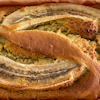
Avocado banana bread

For ➍
250 g flour 
100 g sugar 
1 ts baking powder 
1 ts baking soda/sodium bicarbonate
½ tsp salt 
3 small bananas, very ripe 
120 g low-fat Greek yogurt 
2 ts vanilla extract 
2 eggs 
1 avocado, peeled & pitted

Preheat the oven to 160°C. Line a cake tin (23 x 13 cm) with baking paper.
In a large bowl, mix the flour with the sugar, baking powder, baking soda/sodium bicarbonate and salt.
Mash the bananas with a fork in a medium bowl. Beat in the yogurt, vanilla extract and eggs. Mash the avocado until smooth and make sure there are no chunks left.
Beat the avocado into the banana mixture, add to the flour mixture and stir well to form a thick batter. Pour the batter into the cake tin. (Add sliced banana for decoration).
Bake in the oven for 65 m, until a skewer in the center comes out clean. Let cool on a rack.
When using not ripe enough bananas, bake them 20 m on a baking tray lined with baking paper in the oven at 150 ° C if you want them very ripe, or 30-40 m if they need to be overripe.

Blueberry muffins

For ➊➋ muffins 
100 g butter 
200 ml milk 
grated lemon zest 
2 eggs 
125 g granulated sugar 
1 ts vanilla sugar 250 g flour 
2 ts baking powder 
1 pinch salt 
125 g blueberries (fresh or frozen)

Preheat the oven to 175 ° C for large muffins and 200 ° C for small muffins. Melt the butter and stir in the milk and the grated lemon zest. Beat the eggs with the crystal and vanilla sugar until light and fluffy. Stir the butter mixture into the egg mixture. Sift the flour with the baking powder and salt and carefully fold this into the butter-egg mixture. 
Place paper caisses in a muffin tray. 
Spoon some blueberries in and fill the ⅔ molds with the dough. Bake large muffins 20 m and small 12-15 m in the center of the oven. 
A skewer that you stick in the middle should come out dry.

Irish carrot cake

For +/- ➓ servings
250 g self-raising flour, sieved
250 g sugar or substitute e.g. zusto
1 pack vanilla sugar
1 tsp baking powder
1 tsp baking soda
1 tsp salt
1 tsp cinnamon
400 g finely grated carrots
4 eggs, separated
15 cl cooking oil

Beat egg whites with vanilla sugar to foam. Add sugar/zusto and mix until creamy.
Add egg yolks, salt, baking soda, cinnamon, oil and baking powder.
Mix in the flour and the carrots.
Grease a spring or cake tin with oil. Bake 60 m at 180 ° C.

Decorate with icing sugar or coat the cooled cake with a cream frosting: mix 1 box of Philadelphia cheese, 50 g butter, 100 g icing sugar, 1 pack vanilla sugar.

Torta alla menta soffice (soft mint torte)

For ➋➋ cm cake tin
200 g 00 flour
50 g potato starch
3 medium eggs
130 g caster sugar*
14 cl whole milk
6 cl mint syrup
8 cl peanut or sunflower seed oil
10 g baking powder
1 pinch of salt

Whip the eggs together with the sugar with the electric mixer until they are swollen and foamy.
Add the milk and the mint syrup, continuing to whisk with the whisk.
Sift the 00 flour, the starch and the yeast and place them in the bowl alternating with the seed oil.
Finally add the pinch of salt and stir.
Grease and flour a 22 cm diameter cake tin.
Bake in a static oven and preheated to 160°C for 45-50 m.
Times vary from oven to oven, check with a toothpick to see if it is cooked.
After cooking time, take out the mint cake and let it cool completely before serving.

Sprinkle with icing sugar and serve.
Keep it under a glass jar or well protected from moisture for up to 3 days.

*If you prefer sweeter you can increase the sugar to 150 g.
The color depends on the syrup you use.
Use it as a base to fill with Nutella, chocolate or jamr.
For a gluten-free version you can replace the 00 flour with the one you commonly use or with rice flour. Check that all ingredients are gluten-free, even mint syrup.

French apple cake

For ➑
95 g household flour
¾ tsp baking powder
a pinch of salt
4 large apples, preferably from a different species (Boskoop or Elstar),peeled & quartered
2 large eggs (or three small ones)
150 g sugar
½ tsp vanilla extract
115 g unsalted butter, melted & cooled
3 tbs rum
20 cm cake tin

Preheat the oven to 175°C.
Butter a cake tin of 20 cm.
Mix flour, baking powder and salt thoroughly.
Cut the apple quarters in two, first lengthwise, then again, crosswise.
Beat the eggs until they are frothy with an electric blender. Add the sugar to the eggs, and beat the mixture until it is quite firm.
Add rum and vanilla extract.
Add ½ of the flour mixture, and mix it with the hand..
Add ½ of the butter, and mix it with the hand..
Repeat with the remaining flour and the butter.
Use a rubber spatula to gently mix the apples into the batter. Make sure all the apple pieces have a layer of batter on it.
Pour into the buttered springform pan, and bake for 50 m to an hour.
The top will look golden brown and a knife should come clean out of the cake.
Allow at least 10 m (up to 1 h) cooling in the form. Proceed with a knife around the inside of the mold, to loosen the cake. Place a plate on top of the cake and turn the cake onto the plate, to remove the bottom of the springform pan (it helps again with a knife to cut along the inside of the pan).

Serve warm or cold. With whipped cream if wanted. The cake can be saved for 2 days.
The so-called 'Marie-Hélène French cake recipe' was a hype throughout the world as being the best apple cake recipe ever.

Naked** lemon & olive oil layer cake

For ➊➏ cm cake
350 g all-purpose flour*
1½ ts baking powder*
1 ts baking soda*
1 ts salt*
3 large eggs*
300 g granulated sugar*
37 cl extra-virgin olive oil*
37 cl buttermilk*
2 tbs lemon zest*
¼ ts lemon extract (optional)*
2 ts vanilla extract*
frosting:
250 g unsalted butter, at room temperature*
900 g sugar*
zest of 1 lemon*
1 ts pure vanilla extract*
12 cl whole milk*
lemon zest, as needed for garnish
blueberries, as needed for garnish

Preheat the oven to 175°C. Grease and flour two 16 cmh cake pans.
In a medium bowl, whisk the flour with the baking powder, baking soda and salt to combine.
In the bowl of an electric mixer fitted with the whisk attachment, whip the eggs and sugar until pale yellow and thick, 2 to 3 m.
Add the olive oil, buttermilk, lemon zest, lemon extract (if using) and vanilla extract to the egg mixture and mix well to combine, 1 m more.
Add the flour mixture and mix until just combined, 45 s to 1 m.
Divide the batter between the prepared pans and bake until a toothpick inserted into the center of the cake comes out clean, 30 to 35 m.
Let the cakes cool in the pans for about 15 minutes and then transfer to cooling racks to cool completely.
-
In the bowl of an electric mixer fitted with the paddle attachment, cream the butter while gradually adding the confectioners’ sugar gradually. Mix until light and fluffy.
Beat in the lemon zest, vanilla extract and milk. Mix well to combine.

-
When the cakes are cool, use a serrated knife to cut the domed top off of each cake and then cut each cake into two layers. (You’ll have four layers total.)
Place one cake layer on a platter or cake stand and scoop 1 heaping of frosting on top of it. Using the spatula, spread the frosting into an even layer, all the way to the edge. Place another cake layer on top. Repeat until you’ve used all four cake layers.
Spread the remaining frosting in a thin coat on the top ( and side of the cake*). Run your spatula around the edge of the cake to scrape away any excess frosting. (You should be able to clearly see the cake through the thin layer of frosting.)
Sprinkle with lemon zest and garnish with berries. Slice and serve the cake at room temperature.

*Use half the quantities to bake a 2 layer cake for 4-6 people.
**Naked as in not overfrosted layers. You can eliminatie all outer frosting except the top.

Japanese cotton soft cheesecake

For ➑
225 cream cheese (room temperature)*
10 cl milk
5 large eggs (room temperature)
¼ tbs cream of tartar (or baking soda)
60 g sugar + 60 g sugar
60 g unsalted butter (room temperature)
1 tbs lemon juice
30 g all-purpose flour
2 tbs cornstarch
20 cm round springform pan

Line the bottom and sides of the springform pan with parchment paper. Wrap the springform pan with several sheets of foil, sealing it completely.
Fill a large baking pan halfway with water. Place it in the oven on the lowest rack. Preheat the oven to 160°C.
Separate the eggs and place the egg whites into a mixing bowl and the yolks into a measuring cup.
Beat egg whites on low speed for 30 s. Increase the speed to medium low and beat for another 30 s or until foamy. Add the cream of tartar. Increase the speed to medium high and beat until the egg whites just start to thicken. Add 60 g of sugar gradually. Continue beating until the egg whites reach the soft peaks stage, approximately 3 m.
In a separate bowl, add the cream cheese and milk. Mix on low speed until creamy and smooth (approximately 2-3 m). Add the butter, 60 g sugar and lemon juice and beat for 1 m. Add the flour and cornstarch and mix for another m. Finally add the egg yolks and mix for 1 more m. Strain the batter using a sieve.
Add ⅓ of the egg whites and gently fold into the batter until mostly incorporated. Add another ⅓ and gently fold. Add the remaining ⅓ and gently fold.
Pour the batter into the lined springform pan. Spread the batter evenly into the pan and smooth out the top using a spatula. Holding the sides of the pan, gently lift and drop the pan on the counter about 6 times to remove any big air bubbles.
Place the springform pan into the water bath and bake the cake for 1 h and 10 m. Check the cake for doneness by inserting a toothpick into the center of the cake. It should come out clean. Bake the cake for an additional 10-15 m to brown up the top.
Turn off oven, open the oven the door slightly and let the cake cool in the oven for 1 h.

Remove cake from the pan. Place on a plate and refrigerator for at least 4 h.
Serve with fresh fruit, fruit puree, chocolate sauce, whipped cream, etc.

*Use mascarpone instead.
See a similar video recipe.
Read about Japanese fluffy pancakes.

Flourless chocolate & almonds cake

For ➏-➑
115 g bittersweet chocolate, broken into pieces
6 tbs (85 g) butter
85 g sugar
85 g powdered almond, (ground almonds or almond meal)
1 tbs brewed espresso
1 tbs rum
3 eggs, separated

Preheat oven to 145°C. Line the bottom of a spring form cake pan or a tart pan with a removable base, with parchment paper and butter the sides.
Put the chocolate and the butter in a bowl and melt over barely simmering water. Remove from heat and stir in the sugar, almond powder, rum and coffee until smooth. When the mixture has cooled, mix in the egg yolks, one by one.
In a separate bowl, whisk the egg whites to stiff peaks then fold them into the chocolate batter. Pour into the prepared mold and place in the oven for 45 m.

Allow to cool in the cake pan before unmolding. Sprinkle lightly with powdered sugar before serving.

Microwave cake with ganache frosting

For ➍-➏
10 cl sunflower oil, plus extra for pan
175 g caster sugar
140 g plain flour
3 tbs cocoa
3 ts baking powder
2 large eggs
1 ts vanilla essence
chocolate sprinkles, to serve
for microwave ganache:
100 g dark chocolate, broken into pieces
5 tbs double cream
Grease a 22 cm silicone microwaveable cake pan with a little oil and place a circle of baking parchment in the bottom.
Mix sugar, flour, cocoa and baking powder in a bowl. In a jug, whisk the oil, eggs, vanilla and 10 cl hot water until combined.
Add liquid ingredients to the dry ingredients and mix thoroughly until you have a lump-free batter. Pour mixture into the cake pan and gently tap to pop any air bubbles. Cover with cling film.
Microwave on full power (800 watts) for 7 m. Remove and check if the cake is cooked by poking a skewer into the middle: if it comes out clean it is ready. Allow cake to stand for 5 m, then remove cling film and turn out onto a cooling rack.
For the ganache, melt the chocolate on half power (600 watts) for approximately 2 m, stirring every 30 s until melted. Add the cream and mix thoroughly until smooth and glossy.
Once the cake is cool, spread over the ganache and scatter with the sprinkles.

Serve. The cake will keep for up to 3 days in an airtight container.

Gâteau au yaourt (French yogurt cake)

For ➑
2 large eggs
25 cl whole milk plain unsweetened yogurt
160 g sugar
8 cl vegetable oil
250 g all-purpose flour
1½ ts baking powder
½ ts baking soda
a good pinch of salt
1 ts pure vanilla extract
1 tbs dark rum

Preheat the oven to 180° C  and line a round 25 cm cake pan with parchment paper.
In a large mixing-bowl, gently combine the yogurt, eggs, sugar, vanilla, oil and rum.
In another bowl, sift together the flour, baking powder, baking soda, and salt.
Fold the flour mixture into the yogurt mixture, mixing just until all traces of flour disappear.
Pour the batter into the prepared cake pan, and bake for 30 to 35 m, until the top is golden brown and a cake tester comes out clean.

Let stand for 10 m, then transfer to a rack to cool.

Kasutera (Japanese cake)

For ➍-➑
2 tbs milk
2 tbs honey
4 eggs
170 g sugar
70 g bread flour, sifted

Line a large loaf pan or two small loaf pans with waxed paper. Mix honey in warm milk and set aside. Preheat the oven in 180°C. Whisk eggs in a large bowl using an electric hand-mixer, adding sugar gradually. Place the bowl over warm water in another large bowl and whisk eggs until becomes light yellow (almost white). Mix the milk and honey mixture in. Add sifted flour in the bowl and mix gently with a spatula. Pour the batter in lined loaf pan and tap the pan gently on the table to release any air bubbles. Bake at 180°C for about 10 m and turn down oven to 135°C and bake for about 40 m, or until done. To check if the cake is done, poke it with a bamboo skewer. If the skewer comes out clean it's done. Flip the pan upside down on a cooking sheet or platter and remove the pan from the kasutera.
Remove the waxed paper and cool the kasutera. Wrap it with plastic wrap until the next day. It tastes better the next day. Cut the kasutera into 2 cm thick slices.

Kasutera is a delicious sponge cake made from a few ingredients. It was imported by Portuguese to Nagasaki, Japan in the 16th century. The word "castella" originated from Portuguese "pao de Castella" which means bread from Castilla.

El pagnon boregne (Borinage sugar cake)

For ➑
300 g flour
100 g butter
30 g of fresh yeast
2 eggs
pinch of salt
2 tbs granulated sugar
150 g blonde caster sugar
black coffee

Crumble the yeast in 20 cl warm water and stir vigorously. Melt the butter in the microwave.
Whisk the eggs.
Put the flour in a large bowl. Make a well in the center and pour it in the melted butter, beaten egg, granulated sugar and the dissolved yeast. Mix together with a whisk into a homogeneous dough. Add salt and mix again.
Form a ball of dough and let rise for 1.5 h in a warm place.
Preheat the oven to 180 ° C.
Brush the tin with butter and pour the dough in it. Let it rise for 30 m.
Make holes in the dough with your fingers, without touching the bottom. Spread the caster sugar over the dough, avoiding the edge.
Sprinkle with coffee, spread some in the holes as well.. Put in preheated oven and bake for 35 m.

Serve warm or cooled, with black coffee.
In the North of France and in the Belgian region of the Borinage, tartes au sucre (sugar cakes) are very popular as a simple and inexpensive dessert. In the Borinage and Mons this pagnon (argot for 'compagnon', French for 'company', is a traditional treat.
It is made with cassonade, a blonde or brown rough sugar, that is used in several Belgian desserts and cookies, such as speculaas and spread over pancakes, bread, strawberries... The best known is the Graeffe brand, founded in Brussels in 1848.

Torta alle nocciole (Piedmontese hazelnut cake)

For ➑
200 g shelled hazelnuts, toasted*
150 g flour
3 eggs
200 g sugar
125 g butter
8.5 tbs strong coffee (12.5 cl)
8.5 tbs whole milk (12.5 cl)
1 tbs olive oil
2 tbs rum or Marsala (optional)
1½ tbs baking powder

Preheat the oven to 180°C.
Pulverise the toasted hazelnuts until very fine. Combine with the flour and baking powder.
In a food processor or with beaters, beat the butter and sugar together until smooth and creamy. Add the eggs one by one until well combined. Incorporate with the dry ingredients and mix well. Add the milk, coffee, olive oil and rum and mix until just combined.
Pour into a greased and floured  26 cm cake tin with a removable bottom.**
Bake for about 35 m or until golden brown and springy.

Allow to cool and serve as desired.
Serve with a simple drizzle of honey, a ganache of melted chocolate*** and cream or a simple espresso icing. Or dust with powder sugar.

*To toast hazelnuts, put them in a single layer on a baking sheet in a 180°C oven for about 10-15 m or until lightly browned and the skins look cracked. Watch them carefully as hazelnuts can turn bitter if toasted too long. Remove from the oven and wrap the hazelnuts in a kitchen towel to let steam for a couple of m. Then rub them together to loosen and remove as much of the skin as possible. Cool completely.
**The cake should be 2-2.5 cm thick. A good way is to wrap the mixture in oven aluminum foil completely, then gently press it with your hands into the mold to make it into a nice even round shape.
***To cover the cake in chocolate glaze: gently heat 15 cl heavy cream just to the boiling point and pour over finely chopped 150 g bittersweet or semisweet chocolate (or a combination of the two). Stir slowly until combined. Pour evenly over cake.

Mug chocolate cake @ microwave

For ➊-➋
4 tbs flour, sifted
4 tbs sugar, sifted
2 tbs unsweetened cocoa, sifted
2 tbs whisked egg*
3 tbs milk
3 tbs oil
3 tbs chocolate chips**
splash vanilla or other flavoring, e.g. peppermint or cinnamon
icing sugar

Add all of the dry ingredients to the mug and mix.
Add the egg* and combine well.
Stir in milk and oil.
Add chocolate chips** and splash of vanilla. Stir well.
Microwave for 3 m in a 1000w oven, or 4 m in a 700w oven.
It will crown over the top of the mug, but collapses once the heat stops.

Shake out of the mug. Serve warm with a dust of icing sugar. Or let it cool for about 30 m. Serve with red fruits.

*1 egg is too much, 1 egg white is too eggy, 1 yolk is too dense. Omit egg for a fudgier texture. Or replace with an extra tbs of milk.
**Or a broken up candy bar.

Sharlotka (Russian apple cake)

For ➏-➑
butter for greasing pan
6 large tart apples, such as Granny Smiths
1 lemon
3 large eggs
200 g granulated sugar
1 ts vanilla extract
125 g all-purpose flour
ground cinnamon, canella, to finish
powdered sugar, to finish

Preheat oven to 180°C.
Line the bottom of a 22 cm springform pan with parchment paper. Butter the paper and the sides of the pan.
Peel, halve and core the apples, then chop them into medium-sized chunks. (Or cut them fairly thinly). Sprinkle chunks with lemon juice to keep them from browning.
Pile the cut apples directly in the prepared pan.
Meanwhile, in a large bowl , using an electric mixer or whisk, beat eggs with sugar until thick and ribbons form on the surface of the beaten eggs. Beat in vanilla, then stir in flour with a spoon until just combined. The batter will be very thick.
Pour over apples in pan, using a spoon or spatula to spread the batter so that it covers all exposed apples. Spread the batter and press it down into the apple pile. The top of the batter should end up level with the top of the apples.
Bake in preheated oven for 55 to 60 m, or until a tester comes out free of batter. If necessary, cover with a sheet of foil to avoid too heavy browning.
Cool in pan for 10 m on rack, then flip out onto another rack, peel off the parchment paper, and flip it back onto a serving platter. Dust lightly with ground cinnamon.
Serve warm or cooled, dusted with powdered sugar. Serve with plain black tea.
Optionally, add a dollop of barely sweetened whipped or sour cream.
Sharlotka is a popular Russian dessert, made with autumn ingredients. You can add chopped walnuts to the mixture. The name reminds of a classic apple Charlotte, though that would be much more sophisticated.

Torta (di cioccolato) Caprese (Capri chocolate cake)

For ➓
150 g unsalted butter, room temperature
200 g bitter chocolate
100 g whole almonds, toasted
2 tbs/15 g all purpose flour
4 large eggs, separated @ room temperature
150 g sugar
confectioners' sugar for dusting

Preheat the oven to 190°C. Butter a 20 cm cake pan and line with a circle of parchment paper.
Melt the butter and chocolate together in a bowl over a bain-marie. Set aside and let cool.
Grind the almonds together with the flour in a food processor until fine.
Beat the egg yolks and sugar together in a stand mixer until light colored and fluffy, about 3 to 4 m.
Scrape yolk and sugar mixture into a large mixture. Fold in the melted chocolate mixture carefully.
Add in the almond flour and fold in carefully just until combined.
In a clean stand mixer bowl, whip the egg whites to soft peaks. Carefully scrape them over the batter and fold in gently.
Pour the batter into prepared pan and bake in oven for about 35 to 40 m, until a tester inserted into the center comes out clean.
Let cake cool on rack, then invert onto a plate and remove parchment. Invert cake back onto a serving plate.

Dust with confectioners' sugar before serving.*

*Refrigerate overnight for a softer taste. It will be good for a few days. Always serve at room temperature.
This moist almond chocolate cake was conceived in the 1930's by the Austrian heirs of the painter August Weber at the Strandpension Weber at Marina Piccola at the Italian isle of Capri, and is more Austrian than Italian. Capri was a popular place for European painters. Picture shows a fragment of a 1862 painting by Hungarian painter Antal Ligeti.

Strucolo di ciliege (a Friuli cherries' strudel)

For ➏
350 g flour
warm water or 2 eggs, lightly beaten*
1 ts of vinegar
salt
1 kg cherries, pitted & sliced**
25 g bread crumbs, toasted in a little butter
1 lemon, juiced & zest grated
50 g butter
125 g sugar

Sift the flour on a workplace, make a well in it. Add a pinch of salt, water or eggs, vinegar and knead the mixture well into a smooth dough that does not stick.
Roll the sheet out thinly (1 mm). Let rest for 30 m. Put on a clean kitchen towel and push out the dough into a rectangle.**
Preheat oven to 180°C.
Mix the cherries, bread crumbs, lemon juice, grated zest, butter and sugar together. Spread over the dough. Leave a free border at both side and and on the side close to you.
Lift the end of the towel towards you and gently push the dough to roll up. Use the last border part to seal the package. Seal the left and right borders as well. (Seal with some egg white.)
Put on a sheet of baking paper. Move gently into the oven and bake for 45 m.
Serve slices of the strucolo warm or lukewarm. A good grappa will make excellent company.

*Or just the yolks for a richer dough. Save egg whites for sealing.
**You can use apricots instead: 700 g apricots, pitted, sliced thinly + 80 g sugar + 25 g bread crumbs, browned in a little unsalted butter + 25 g butter. Change the filling to apples (and raisins). Walnuts and raisins with some rum and chocolate will do as well.
***As the dough is not sugared, it can be used for savory filling as well.
Until the end of the First World War, the Goriza province of the Alpine Friuli stayed a part of the Austro-Hungarian Empire. The other provinces of the Carso plateau were already turned over to Italy in 1866, but stayed more central European than the rest of Italy. It has developed a cuisine that's close to Austrian and German cuisine.
This struciolo seems a variation of the classic Austrian Apfelstrudel, made with apples. This one, with cherries, is called Weichselstrudel in German. It goes well with the Trieste goulash (Gulyas alla Triestina) or Friuli winter salad for a hearty winter meal.
The strudel is a variation to the Ottoman cuisine baklava, made with flaky phyllo dough (which some cooks use as a replacement), and may have been developed in the Byzantine era. During Turkish occupation of central Europe in the 16th and 17th century, baklava shifted in some of these areas to a filling with apples, and a high gluten dough. From the former Turkish territories Croatia and Bosnia, close enough to Friuli to have a been a direct influence, and Hungary, it came to Austria, and became popular in the whole former Habsburg Empire and Germany. By immigration from central Europe, it spread to the United States, Israel and Brazil.