For ➍-➏500 g carrots
For ➍-➏
For ➍1 cauliflower
½ pumpkin
4 handfuls of rocket
200 g cooked chickpeas
200 g wheat semolina
120 g feta* or 20 falafels
4 tbs olive oil
4 ts ground garlic, paprika, cumin
sauce*:
3 tbs olive oil
1 tbs honey
1 tbs mustard
1 lemon, juiced
1 clove crushed garlic
finishing:
pomegranate
coriander
Preheat the oven to 200°C
In the meantime, cut the cauliflower and pumpkin into pieces of about 2 cm. Drain and rinse the chickpeas.
Divide the cauliflower and pumpkin pieces on a plate and brush them with half of the herbs and olive oil.
Do the same with the chickpeas on a second plate.
[Or spread everything out on a large baking tray].
Bake everything for 40 m.
Cook the wheat semolina with boiling water.
Prepare the sauce. Mix the olive oil, honey, mustard, lemon juice and the crushed garlic clove in a bowl.
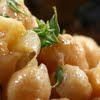
Prepare the winter tabouleh by combining the rocket, semolina and roasted vegetables. Drizzle with the sauce, sprinkle with crumbled feta or add the falafels and mix again. If desired, finish with fresh pomegranate and coriander. Serve warm.
The tabouleh salad can be stored in an airtight container in the refrigerator for 2-3 days.
*Double the quantity of sauce for more taste.
For ➍
For ➍
For ➍
For ➍
For ➍
For ➍Kibbeh, Arabic for 'balls', can be made from lamb, camel or beef. Sometimes they are covered in mashed potatoes before baking. Serve them while still hot, with a salad, like in this proposition, while or a snack with yogurt (or sour cream) and lime wedges. They can also be served at room temperature and they go great with pita bread, hummus, babaganoush and/or tabbouleh.
Kibbeh look-alikes are calle quibe or kibe in Portuguese. In the Dominican Republic they call it quipe or pipe.
Fattoush is a classic Lebanese bread salad, that can be eaten on its own or with meat.
For ➍
For ➍
For ➍
For ➍/ 50 clIn 1953, the Mexican communist painter Frida Kahlo painted this Naturaleza Muerta Con Sandias (Still Life with Watermelon), coming close to the ingredients of a pico de gallo, combining fruit and peppers, in ever changing combinations, depending on the region. Sometimes it is closer to a (fruit) salad than a sauce, especially when the pieces are roughly chopped in not too small pieces. (Artist suggestion from the wonderful Feasting on Art site.)
Try the similar salsa fresca.
Or the green mango variation.
For ➍
For ➍
For ➋-➌
For ➍
For ➋-➍Read a tip on cooking dried chickpeas.
For ➋'Korma' means 'braising' in Hindi and Urdu. The technique was developed in the 16th century with the introduction of Mughlai kitchen, close to Persian and Turkish cuisines, in the Mughal empires in Northern India. Despite the varying flavouring of different korma, it should always be made with with yogurt of some sort. Today, in Europe or UK, it is sometimes reduced to a creamy version of a curry, with chicken korma as the signature dish.
Yogurt, fermented milk, has been used since 3000 BC, and has been a main staple of Arab, Turkish and Central Asian cuisine. Use stirred yogurt for cooking. Or strained 'Greek' yogurt.
This is a quick and easy version of Indian korma. Traditionally, it would be made with ghee instead of oil.
For ➋*A sophisticated 21st century twist on the popular 70's mix Campari orange mix. The herbal bitterness of the Campari, the tart sweet sourness of the blood orange and the sparkling bitter of the brut mix together well. Campari orange was mainly an American invention, quickly followed by Western European countries. In Italy, it is still drunk as an aperitivo, with soda water to release the bitter fragrances of quinine, rhubarb, ginseng, orange peels and aromatic herbs. The aperitivo was launched in the 1840's, to counter the bitter sweet cordials from Holland, spreading over Europe. It was mainly drunk as an opener, 'apertitiuvum' in Latin, to speed up the appetite for the coming dinner. Bitters have long been considered to stimulate digesting.
Campari is also used as a main ingredient for the Negroni (equal parts gin, white vermouth, Campari on ice) and James Bond favourite Americano (white vermouth, Campari and a splash of soda on ice) cocktails. It has become fashionable again, due to extensive marketing, including lush limited edition calendars.
Read more on twisted cocktails: fino martini, quick mint cider.
For ➑ servingsA canut is a silk weaver, especially in the Lyon region, where the silk industry was developed in in the 18th century with introduction of the mechanical Jacquard looms, replacing the manual home looms. 'Cervelle' is French for brain, the combination meaning 'silk weaver's brain', which might have been an insult, or mean language of the rich owners of the factories. The mercilessly exploited canuts staged two major uprisings in 1831 and 1834, becoming an example for workers' revolts in the 19th century.
More recipes from the Lyon region: matefaim salé, braised chicken with cream sauce, salade lyonnaise.