Showing posts with label dessert. Show all posts

Austrian Linzer Torte

For ➑ portions
75 g blanched almonds 
75 g blanched hazelnuts 
250 g plain flour 
225 g butter 
130 g light brown sugar 
1 egg 1 tsp cinnamon 
⅛ ts cloves 
¼ ts salt 
zest of 1 lemon 
280 g redcurrant jam* 
1 egg yolk 
almond flakes for decoration 
 
Grind the almonds and hazelnuts and place in a bowl. Add the flour, salt, cloves, cinnamon, lemon zest, light brown sugar and butter. Use a pastry cutter/blender or two knives to cut the butter into the remaining ingredients until crumbly. Then add the egg. 
Knead into a dough with your hands. Form the dough into a ball, wrap in cling film and leave to rest in the fridge for at least 30 m. 
Preheat the oven to 175°C. Take ⅔ of the dough and press it into a 26 cm baking tin. Make sure the bottom is completely covered with dough with a thick edge of 1 cm thick. Add the jam, make sure the entire bottom of the tart is covered with jam. 
Cut the rest of the dough into strips. Place the strips on the tart and make a nice lattice pattern on it. Brush the dough with egg yolk. Decorate the Linzer Torte with some almond shavings and bake it in the oven for 45-60 m. 

* (or raspberry jam)

♥︎Fat-free apple cake

For ➑
3 eggs
1 tbs cold water
150 g granulated sugar
1 sachet vanilla sugar
3 apples
dash of lemon juice

Preheat the oven to 175°C hot air. Separate the eggs and first beat the egg whites until stiff together with a spoonful of cold water and the vanilla and granulated sugar (I only added these when the egg whites were almost stiff). Then add the three egg yolks and continue mixing for a while. Then sift the flour and fold it into your batter.
Peel 2 apples, cut them into small pieces and mix them with the lemon juice. Fold them into your batter as well. Place baking paper on the bottom of a springform pan. Lightly grease the edges. Pour the dough into the baking pan. Peel the third apple. Cut into slices and arrange on top of the cake. Bake until the cake skewer comes out dry, about 45-50 m.

apple,cake,dessert,egg,lemon,flour,

♥︎Walnut cake with coffee

For ➑-➓ portions
4 eggs
150 zusto (or sugar)
100 spelt wholemeal flour
50 g chopped walnuts*
handful of walnut halves for decoration*
2 tbs instant coffee, dissolved in 2 tbs hot water
1 pack of dry yeast

Split eggs. Beat yolks with sugar until foamy.
Mix flour, yeast, dissolved coffee and chopped nuts into the foam.
Beat egg whites into snow. Mix egg whites beaten into snow with the flour mix.
Line a baking tin with baking paper.
Finish with walnut halves.*
Bake 45 m at 160°C.

*Or pecans.

Easy clafoutis

For ➏-➑
30 g unsalted butter*
400 g cherries, pitted**
75 g wheat flour***
1 pinch of salt
65 g white caster sugar****
3 medium eggs
30 cl whole milk*****
2 tbs powdered sugar

Preheat the oven to 190 °C. Melt the butter in a saucepan over low heat, stirring frequently. Grease the cake tin (Ø 24 cm) with some extra (not melted) butter. Sprinkle with some flour.
If necessary, pit the cherries and divide them over the cake tin. Sift the flour into a bowl and mix in the salt and sugar. Beat in the eggs, followed by the milk and melted butter, until no lumps remain.
Pour the batter over the cherries. Bake the clafoutis in the center of the oven for 30 m until done and golden brown. 
Remove the mold from the oven and sprinkle the clafoutis with the icing sugar. 
Serve warm.

*replace with vegetable butter or oil
**Unpitted cherries release less moisture
***Replace 25 g with almond flour
**** Replace with sugar substitute
***** Replace if necessary. by lactose-free milk or vegetable variant


Japanese cotton cheesecake

For ➏
175 g cream cheese* (or lactose-free or vegetable)
14 cl milk (or lactose-free or vegetable)
45 g butter (or lactose-free or vegetable)
100 g granulated sugar (or susto)
5 fresh eggs
45 g flour
15 g cornstarch
grated zest & a squeeze of juice from ½ lemon
1 pinch of salt
butter or oil to grease the baking pan
extra squeeze of lemon for cleaning bowl
round baking tin with a diameter of 18 cm and a height of 8 cm
baking paper

Grease the baking pan. Place a cut out sheet of baking paper on the bottom that fits exactly in it and line the side with baking paper as well. By greasing the baking pan first, the baking paper will stick.
Preheat the oven to 160°C.
Melt the cream cheese, milk and butter over very low heat, stirring occasionally. Remove from heat once everything has melted and set aside.
Degrease the bowl for the egg whites with a squeeze of lemon juice.
Separate the egg yolks from the whites, the yolks in a large bowl (where you will make the batter shortly) and the whites in the degreased bowl.
Beat the yolks with about ⅓ of the sugar until dissolved. Stir in the cream cheese mixture with a spatula until well blended. Now mix the cornflour with the flour and sieve into the cream cheese mixture. Pour the batter one more time through the sieve into another bowl to remove any lumps. Stir in the grated lemon zest with a spatula.
Add a pinch of salt and a squeeze of lemon juice to the egg whites and beat with a mixer until foamy. Add about ⅓ of the remaining sugar and beat 1 m until dissolved. Repeat this step 2 times with the rest of the sugar. If necessary, mix 1 m further until you have semi-rigid peaks. When you take the mixer out, the peak hanging from it should still fall to the side a little and not stay upright.
Stir ¼ of the egg white foam into the batter with a spatula. Everything should be well mixed, but without too much air coming out of the whipped egg whites.
Pour this batter into the bowl with the rest of the beaten egg whites and stir gently with a spatula until there are no more streaks in the batter.
Pour the batter from a certain height into the baking tin (this will release unnecessary air bubbles). Place the tin in a large baking dish (or au bain-marie dish). Fill the bowl with hot water so that part of the baking pan is submerged.
Place the  baking dish in the preheated oven for 75 m.
Turn off the oven, but leave the cake inside with the door closed for another 15 m. Take out and immediately turn over using a large plate so that the cake is upside down. Carefully remove the baking pan and paper. Let rest 15 m and then turn the cake over so that it is upright again.
If necessary, serve with fresh red or exotic fruit.

*full Philadelphia e.g.

Easy cotton cheesecake

For ➑
255 g white chocolate 
225 g cream cheese, room temperature*
6 large eggs, separated, room temperature
20 cm round (springform) pan

Preheat oven to 175°C°. 
Line bottom and line sides of a 20 cm cake pan with buttered or oiled parchment paper. Or make the paper wet to avoid fat. Center the pan on a large piece of foil and fold foil up over the sides to prevent water from entering pan.
Place white chocolate in a medium heatproof bowl and heat in microwave in 20-s intervals (or Break the chocolate into pieces and place it in a large bowl. Melt the chocolate in a double boiler over hot water (60°C).  Add the cream cheese and melt them together, stirring occasionally, until melted.  Let cool slightly, then add yolks and stir to combine.
Using an electric mixer on high speed, whip egg whites in another large bowl until stiff peaks form. Add a small portion of egg whites to chocolate mixture and stir just until lightened. Gently fold in remaining egg whites in 2 additions until just combined.
Pour batter into prepared pan. Place pan in a baking dish or roasting pan and add warm water to reach halfway up sides of cake pan. Bake cheesecake until set, 40–45 m. Turn oven off and leave pan in oven 15 m, then transfer to a wire rack and let cool completely. Remove cheesecake from pan, transfer to a platter, and chill until cold, at least 4 h or up to overnight.
Serve with some fruit.

*variant smaller version with 200 g cream cheese, 225 g white chocolate, 5 eggs

Easy cotton cheesecake (small)

For ➍-➏
3 eggs, room temperature
120 g white chocolate
120 g cream cheese, softened, room temperature
15 cm round (springform) pan

Preheat the oven to 170°C. 
Separate the eggs. Place the whites in a large bowl and keep them in the refrigerator in preparation for the meringue.
Break the chocolate into pieces and place it in a large bowl. Melt the chocolate in a double boiler over hot water (60°C). Add the cream cheese and melt them together. Remove the bowl from the double boiler. Let the mixture cool down. Add the egg yolks, and mix well.
In a large bowl, whip egg whites with an electric mixer until firm peaks form (to make a meringue). 
Add  ⅓ of the meringue into the cream cheese batter and blend well with a spatula. Then add the rest of the meringue ½ at a time and mix well.
Rub some oil/butter on parchment paper to prevent cracking.  
Or make the paper wet to avoid fat. Line the round cake pan with the parchment paper. Pour the batter into the pan and drop the pan lightly on the counter to raise the air bubbles out of the batter.
Place the cake pan on a baking tray. Pour some hot water into the baking tray. Bake at 170°C  for 15 m, at 160°C for 15 m, then stop the heat and bake with the remaining heat for 15 m.
When it is done, place the cake pan on a wire rack to cool completely. 
/Brush with apricot jam syrup, add whipped cream and/or dust with powdered sugar if desired. Or serve with some fruit./
Serve immediately or chill in the fridge before serving. Cake will slightly harden in the fridge, so leave at room temperature for a few m before you serve.

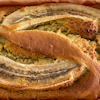
Avocado banana bread

For ➍
250 g flour 
100 g sugar 
1 ts baking powder 
1 ts baking soda/sodium bicarbonate
½ tsp salt 
3 small bananas, very ripe 
120 g low-fat Greek yogurt 
2 ts vanilla extract 
2 eggs 
1 avocado, peeled & pitted

Preheat the oven to 160°C. Line a cake tin (23 x 13 cm) with baking paper.
In a large bowl, mix the flour with the sugar, baking powder, baking soda/sodium bicarbonate and salt.
Mash the bananas with a fork in a medium bowl. Beat in the yogurt, vanilla extract and eggs. Mash the avocado until smooth and make sure there are no chunks left.
Beat the avocado into the banana mixture, add to the flour mixture and stir well to form a thick batter. Pour the batter into the cake tin. (Add sliced banana for decoration).
Bake in the oven for 65 m, until a skewer in the center comes out clean. Let cool on a rack.
When using not ripe enough bananas, bake them 20 m on a baking tray lined with baking paper in the oven at 150 ° C if you want them very ripe, or 30-40 m if they need to be overripe.

Strudel di mele
(apple strudel)

For ➍-➏
 for the dough:*
150 g flour 
a pinch of salt 
2-3 tbs granulated sugar 
1 egg 
2-3 tbs olive or vegetable oil (or melted butter) 
water
for the filling:
750 g (1-2) apples 
75 g granulated sugar
handful of raisins, pre-soaked in rum 
handful of pinoli (pine nuts), or slivered almonds 
1-2 tbs cinnamon 
75 g breadcrumbs 
a good nob of butter 
for baking and finishing: 
more flour 
melted butter 
powdered sugar 

If using homemade dough, prepare it by mixing the dry ingredients, then the egg and oil, then finally just enough water to form a ball. Knead briefly until the dough is soft and elastic. Wrap the dough in plastic wrap, then in a towel, and let rest for a good 30 m or more. 
While the dough* is resting, peel, core and slice the apples as thinly as you can. 
Add the sugar, cinnamon and raisins, drained and squeezed dry, and the pine nuts or almonds.  Mix things all together, moistening the mixture with a bit of the rum in which the raisins have been soaked. Set aside. 
Sauté the breadcrumbs in the melted butter over very gentle heat until they are lightly browned. Do not over-brown the crumbs. When the dough* has rested at least a good 30 m, mold it into a flat, rectangular shape and place it on a well-floured cotton dish towel. 
Roll the dough* out as thinly as you can manage into a large, rectangular shape. Older recipes tell you to stretch it further with your hands, as you might a thin-crust pizza.
Brush the dough* liberally with melted butter, leaving the edges dry.  Spread the sautéed breadcrumbs in a thin layer all over the dough, leaving the edges clear. 
Pour the filling over the breadcrumbs and spread it out even, again avoiding the edges. 
With the aid of the towel, roll up the dough into a large lozenge-shaped loaf. 
Once the strudel is fully rolled up, tuck the edges under and, very gently, transfer this loaf onto a baking pan or sheet. Brush the loaf liberally with melted butter. If you prefer a ‘shiny’ surface to your strudel, brush the surface with milk or egg wash instead. 
Bake the strudel in a hot (200°C) oven for a good 30-45 m, until golden brown all over. (I find it helps browning if you brush it once or twice with more melted butter while it bakes.) Let the strudel cool entirely. Top with powdered sugar before serving in thick slices, perhaps with a nice side of whipped cream or ice cream if you’re feeling decadent.

*If using store-bought pastry dough, just lay it out flat on the sheet it is usually attached to and lay the breadcrumbs and filling out on top, then roll it up as usual. You won't need to brush it with butter, as pastry dough already has a high fat content, [although brushing it with milk will help it brown]. Use puff pastry or phyllo dough, which makes a particularly delightful Strudel, lay out one sheet, brush it with melted butter, then repeat until you have 4 or 5 layers of dough, before laying on the breadcrumbs and apple filling.

Almond & banana bread

For ➓ servings
1 tbs coconut oil
3 eggs
120 g almond flour
2 ripe bananas *
1 tbs baking powder
1 tbs cinnamon
1 pinch sea salt
50 g almonds, roughly chopped
3 tbs raisins (or dried cranberries, blueberries ...)
2 tbs almond flakes

Preheat the oven to 180 ° C.
Mix the eggs with the almond flour, bananas, baking powder, cinnamon, a pinch of salt and melted coconut oil in a blender or food processor.
Drain the batter from the blender / food processor, add the nuts and raisins (or dried cranberries) and mix well with a spoon.
Grease the cake tin (or use a silicone baking tin). Put everything in the cake tin, sprinkle the almonds on top and bake about 40 m in the preheated oven. Prick the bun with a wedge to see if it is cooked. The wedge must be dry. If the bun becomes too dark, cover it with baking paper.
* Replace if necessary. 1 banana by 3 tbs apple sauce

Lemon curd biscuits

For ➋x➓ cookies 
125 g butter, cold 
225 g flour 
125 g sugar 
1 egg zest of 1 lemon 
100 g lemon curd 
salt 
powdered sugar 

Cut the butter into cubes. Mix with flour, sugar, egg, a pinch of salt and the zest of a lemon in the bowl of the food processor. Knead it into a firm dough. If the dough is still too dry, add 1 tbs of ice-cold water if necessary. Wrap the dough in cling film. Let it rest for at least 30 m in the refrigerator. Preheat the oven to 170 ° C. Remove the dough from the fridge and form balls the size of a 2 euro coin. Place them on a baking tray lined with parchment paper. Press a hole in the dough with your thumb or with a spoon. Divide 1 ts lemon curd over the hole. 
Bake the lemon curd cookies in the oven in about 15-20 m. 
Let them cool on a cooling grid. 
Sprinkle them with icing sugar when they have cooled down. 
Store the lemon curd cookies in an airtight container.

Lemon curd

For ➊ pot (about 150 g) 
2 eggs 
2 lemons, grated peel & juice 
200 g sugar 
115 g butter 

Heat the sugar and the butter au bain marie. Add the lemon juice and lemon zest. Beat the eggs in a bowl. Add to the lemon mixture. Keep stirring continuously until the mixture has thickened. The mixture should be about the thickness of yogurt, sometimes it takes up to 10 m. 
Put the lemon curd in a sterilized jar and keep it in the refrigerator (up to 3 weeks).

Blueberry muffins

For ➊➋ muffins 
100 g butter 
200 ml milk 
grated lemon zest 
2 eggs 
125 g granulated sugar 
1 ts vanilla sugar 250 g flour 
2 ts baking powder 
1 pinch salt 
125 g blueberries (fresh or frozen)

Preheat the oven to 175 ° C for large muffins and 200 ° C for small muffins. Melt the butter and stir in the milk and the grated lemon zest. Beat the eggs with the crystal and vanilla sugar until light and fluffy. Stir the butter mixture into the egg mixture. Sift the flour with the baking powder and salt and carefully fold this into the butter-egg mixture. 
Place paper caisses in a muffin tray. 
Spoon some blueberries in and fill the ⅔ molds with the dough. Bake large muffins 20 m and small 12-15 m in the center of the oven. 
A skewer that you stick in the middle should come out dry.

Lemon tart with goat yogurt & speculaas

For ➑
6 gelatin sheets
150 g speculaas / gingerbread
150 g pecans
1 tbs lemon zest
80 g butter
lemon juice from ½ lemon
1 l goat yogurt
200 g lemon jam or lemon marmalade

Soak the gelatin sheets in cold water for 10 m.
Put the biscuits in a bowl and grind finely with a mixer or mortar. Do the same with the pecans. Combine gingerbread and nuts. Add 1 tbs of lemon zest and toss again.
Melt the butter in the saucepan and add the speculaas & nut mixture. Stir together.
Place baking paper on the bottom of the baking tin. Grease or spray the baking rim with butter and stick a strip of baking paper against it. Spoon in the gingerbread nut bottom and press evenly.
Put the lemon juice in a saucepan and place the gelatin leaves in it. Heat this on low heat and let the gelatin leaves dissolve.
Now stir the mixture into the goat yogurt. Stir well and pour this mixture into the pie tin.
Leave to set in the refrigerator for at least 2 h.

Take the tart out of the fridge and spoon the lemon jam or lemon marmalade on it.
Serve for breakfast or as a fresh snack

Irish carrot cake

For +/- ➓ servings
250 g self-raising flour, sieved
250 g sugar or substitute e.g. zusto
1 pack vanilla sugar
1 tsp baking powder
1 tsp baking soda
1 tsp salt
1 tsp cinnamon
400 g finely grated carrots
4 eggs, separated
15 cl cooking oil

Beat egg whites with vanilla sugar to foam. Add sugar/zusto and mix until creamy.
Add egg yolks, salt, baking soda, cinnamon, oil and baking powder.
Mix in the flour and the carrots.
Grease a spring or cake tin with oil. Bake 60 m at 180 ° C.

Decorate with icing sugar or coat the cooled cake with a cream frosting: mix 1 box of Philadelphia cheese, 50 g butter, 100 g icing sugar, 1 pack vanilla sugar.

French Japanese cheesecake

For ➍ cakes
180 g milk
260 g Philadelphia cream cheese
240 g egg yolk
4 g zest of lime
80 g patisserie flour (T45)
80 g potato starch
530 g egg white
160 g granulated sugar
butter

Heat the milk with the Philadelphia, add the egg yolk and the lime zest.
Sift the flour and the potato starch, stir into the milk mixture. Beat the egg whites with the gradually added sugar into meringue. Gently stir it into the milk preparation.
Butter 4 small baking tins, sprinkle with flour. Fill each dish with 400 g of the batter, bake for 90 m at 140°C.

Remove from the mold, immediately cover with kitchen foil.
A variation on Japanse cheesecake by French chef Yannick Alléno.
Classic Japanese cheesecake recipes here.

Torta alla menta soffice (soft mint torte)

For ➋➋ cm cake tin
200 g 00 flour
50 g potato starch
3 medium eggs
130 g caster sugar*
14 cl whole milk
6 cl mint syrup
8 cl peanut or sunflower seed oil
10 g baking powder
1 pinch of salt

Whip the eggs together with the sugar with the electric mixer until they are swollen and foamy.
Add the milk and the mint syrup, continuing to whisk with the whisk.
Sift the 00 flour, the starch and the yeast and place them in the bowl alternating with the seed oil.
Finally add the pinch of salt and stir.
Grease and flour a 22 cm diameter cake tin.
Bake in a static oven and preheated to 160°C for 45-50 m.
Times vary from oven to oven, check with a toothpick to see if it is cooked.
After cooking time, take out the mint cake and let it cool completely before serving.

Sprinkle with icing sugar and serve.
Keep it under a glass jar or well protected from moisture for up to 3 days.

*If you prefer sweeter you can increase the sugar to 150 g.
The color depends on the syrup you use.
Use it as a base to fill with Nutella, chocolate or jamr.
For a gluten-free version you can replace the 00 flour with the one you commonly use or with rice flour. Check that all ingredients are gluten-free, even mint syrup.

Marinated orange carpaccio & Aperol granita

For ➍
8 oranges, 4 for serving
2 tbs pistachios, minced
fresh mint
granita:
2.5 dl Aperol
2.5 dl water
200 g sugar
zest of 1 orange
marinade:
2 dl fresh orange juice
50 g sugar
½ vanilla pod
½ ts pink peppercorns
1 quill cinnamon
1 star anise
lemon peel & orange zest for decoration

Prepare the granita the day before. Bring the water and sugar to a boil. Let this syrup cool. Dilute 2.5 dl Aperol and add 2.5 dl syrup. Finish with orange peel and mix carefully. Pour into the ice cube tray and freeze for 12 h.*
For the marinade: bring all ingredients to a boil and let cool in the fridge.
Peel 1 orange per person, cut into thin slices and arrange on a freezer cooled deep plate.
Pour a little marinade over it. Decorate with mint and minced pistachios.

Just before serving, place a scoop (or a nice ball) of granita* over it.

*To make the granita ready for serving, mix lightly in a food processor. Continue with a fork.
The traditional method is to freeze the liquid for 2 h, or until the mixture is frozen around the edges. With a fork, draw ice from the edges towards the centre. Return to the freezer, and then repeat this process about 3-4 times, every 30 m, or until all of the granita mixture is formed of ice crystals. Serve immediately.

Japanese fluffy pancakes

For ➌-➍ pancakes
2 eggs
18 cl buttermilk
½ ts vanilla
¼ ts salt
60 g flour
1 ts of yeast
¼ ts baking soda (or baking powder)
2 tbs vegetable oil
maple syrup

Put the eggs, buttermilk, sugar, vanilla and salt in a blender and mix at low speed for a few s.
Add flour, yeast and baking soda. Continue mixing for 15/20 s.
Heat a skillet over medium heat and spread the vegetable oil inside a crown mold*.
Pour the remaining oil into the pan and place the pan in the center.
Heat for a few m before pouring the pancake dough halfway up the pan.
Cook until bubbles form at the top of the pancake.
Use a spatula to gently flip it over and cook for another 3 m.**

Serve (with maple syrup if wanted. Or ice cream. Or put some butter on top before dripping the syrup].

*Make the form yourself: cut a thin sheet of cardboard into two long strips about 4 cm wide and 31 cm long. Do the same with parchment paper. Then staple the parchment paper onto the cardboard, form it into a circle shape, and staple it closed (with the parchment paper on the inside).
**Another method suggests cooking over really low heat, covering the pan with a lid, and slowly cooking for 20 m. When bubbles appear, flip over, put the lid on aigain and cook for 20 m more m.
Read about the Japanese cotton soft cheesecake.

French apple cake

For ➑
95 g household flour
¾ tsp baking powder
a pinch of salt
4 large apples, preferably from a different species (Boskoop or Elstar),peeled & quartered
2 large eggs (or three small ones)
150 g sugar
½ tsp vanilla extract
115 g unsalted butter, melted & cooled
3 tbs rum
20 cm cake tin

Preheat the oven to 175°C.
Butter a cake tin of 20 cm.
Mix flour, baking powder and salt thoroughly.
Cut the apple quarters in two, first lengthwise, then again, crosswise.
Beat the eggs until they are frothy with an electric blender. Add the sugar to the eggs, and beat the mixture until it is quite firm.
Add rum and vanilla extract.
Add ½ of the flour mixture, and mix it with the hand..
Add ½ of the butter, and mix it with the hand..
Repeat with the remaining flour and the butter.
Use a rubber spatula to gently mix the apples into the batter. Make sure all the apple pieces have a layer of batter on it.
Pour into the buttered springform pan, and bake for 50 m to an hour.
The top will look golden brown and a knife should come clean out of the cake.
Allow at least 10 m (up to 1 h) cooling in the form. Proceed with a knife around the inside of the mold, to loosen the cake. Place a plate on top of the cake and turn the cake onto the plate, to remove the bottom of the springform pan (it helps again with a knife to cut along the inside of the pan).

Serve warm or cold. With whipped cream if wanted. The cake can be saved for 2 days.
The so-called 'Marie-Hélène French cake recipe' was a hype throughout the world as being the best apple cake recipe ever.