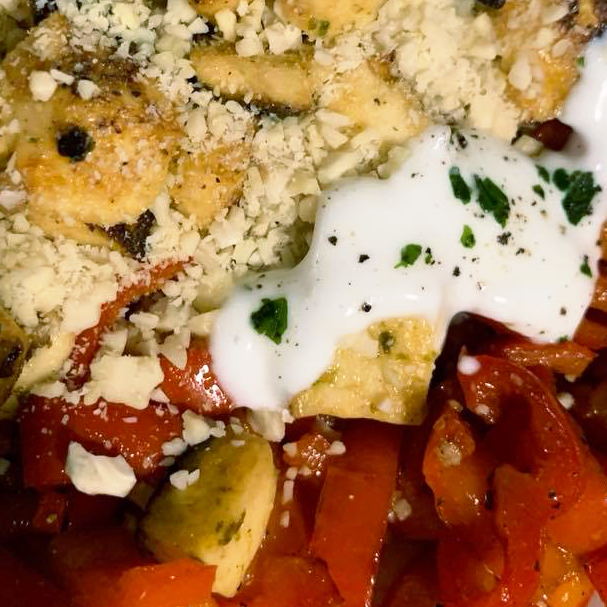
Showing posts with label cheese. Show all posts

Gnocchi with mushrooms & sage

For ➍
2 ts ground black pepper 
olive oil 
1-2 tbs white balsamio vinegar 
300 g mixed mushrooms, torn into large pieces 
15 sage leaves 
sea salt 
250 g gnocchi 
100 g Parmigiano, finely grated 
50 g Pecorino, finely grated 

Toast the peppercorns in a large, hot, dry skillet over medium heat until fragrant. Then crush them coarsely in a mortar and set aside. Place the skillet back on the heat and heat a deep layer of olive oil in the skillet. Add the sage leaves and fry for 1 m, until nice and crispy. 
Remove the sage leaves from the pan and add the mushrooms. Fry them for about 5-10 m. Season with salt. Meanwhile, bring a large pot of salted water to a boil. Add the gnocchi and cook them for 2-3 m until they float to the surface. Scoop them out with a slotted spoon and reserve 10 cl of the cooking water. 
Add the roasted ground peppercorns to the mushrooms. Add the white balsamico vinegar. Also add (part of) the pasta water and let simmer for 2 m, until the liquid has reduced by half. 
Add the drained gnocchi to the pan and toss them in the sauce. Also add the cheeses immediately and mix until the sauce is smooth. Divide the mushroom gnocchi among the plates and finally sprinkle with extra cheese. Serve the mushroom gnocchi with a salad. 

Fregola Sarda alla vongele (fregola with clams)

For ➋
200 g fregola Sarda
500 g vongele clams
3 cloves of garlic, pressed or chopped
1 sweet onion, finely chopped
2 stalks of celery, finely chopped
15 cl white wine
100 g Parmigiano
2 tbs mascarpone
zest of 1 lemon
handful of parsley, finely chopped
salt & pepper
olive oil

Fry the onion and garlic in a dash of olive oil over medium heat until they start to colour. Add the celery and let it stew a little. Rinse the clams well under cold water and let them drain. Add them to the pan and deglaze with the white wine. Let them cook for 3-4 m with the lid on until the clams open. Remove them with a slotted spoon, so that the cooking liquid remains in the pan. 
In the meantime, cook the fregola as indicated on the packaging (probably 10 m). 
Let the clam juice in the pan simmer for another 2-3 m for extra flavour. 
Add the cooked fregola to the pan with the reduced clam juice. Stir in the mascarpone, salt and pepper, chopped parsley and grated Parmigiano. Add the clams (either shelled or with shells). Finish with some extra pepper, a drizzle of olive oil and some more parsley.

Green apple & kale salad

For ➍
3 cups ribbed & chopped kale or borecole
handful of chopped parsley
1 cup cooked black lentils
1 green apple, diced
1/2 English cucumber, diced
½ cup toasted pumpkin seeds
1 cup shaved Parmigiano, or feta or goat cheese
dressing
one clove garlic
1 tbs honey
1 tbs Dijon mustard
juice of 1 lemon
¼ cup pumpkin seed oil or extra virgin olive oil
salt &pepper

In a large salad bowl, combine the kale, parsley, lentils, apples, cucumber, pepitas and parmesan.
For the dressing, blitz everything in a food processor or blender, with salt and pepper to taste, until the garlic is smooth.
Pour the dressing on the salad and toss well to coat. Garnish with more cheese if you wish. The salad will keep in the fridge for a full day and slowly loose it's crunch from there.

Couscous with halloumi & fried red pepper

For ➍
4 red peppers, cut into strips
335 g whole grain couscous
40 g raisins
40 g almonds, roughly chopped
2 cloves of garlic, pressed or finely chopped
20 sprigs fresh cilantro, finely chopped
2 limes
250 g halloumi, cut into 1-2 cm cubes
125 g fat yogurt
70 cl vegetable stock
3 tbs olive oil
4 tbs extra virgin olive oil
pepper & salt

Grate the zest of the lime. Squeeze the lime.
In a salad bowl, mix the couscous and raisins with the stock and allow to soak, covered, for 10 m. Then stir with a fork.
Heat ½ of the olive oil in a frying pan over a medium heat and fry the pepper strips 7 - 9 m. Season with salt and pepper.
Meanwhile, heat the remaining olive oil in another frying pan over medium heat and fry the lime zest and garlic for 30 s.
Add the cubes of halloumi, fry for 3 - 4 m until crispy. Then remove them from the pan.
Fry the soaked couscous 1 - 2 m in the same pan in the lime-garlic oil.
Mix the coriander with the couscous and season with the extra virgin olive oil, pepper and salt.
Divide the couscous over the plates and scoop the bell pepper strips on the side. Drizzle the couscous with the lime juice and garnish with the halloumi and almonds. Serve the yogurt separately, so that everyone can add it to their own taste.

Moussaka

For ➍ 
600 g potato, sliced 
2 large eggplants, in thin slices of 3 mm. 
2 tbs flour or cornflour oil (for frying) 
handful of fresh parsley (for garnish) 
300 g minced beef or vegetarian minced meat 
1 onion pinch of oregano 
2 cloves of garlic 
1 ts cinnamon 
2 tbs tomato paste 
40 cl tomato cubes 
béchamel:*
30 cl of milk 
30 g butter 
30 g flour 
1 bay leaf 
50 g grated cheese 
pinch of nutmeg 
1 egg 

Heat a grill pan. Brush the eggplants with a little oil and sprinkle with a little salt and pepper. Grill them nicely brown and then sprinkle with a little flour. 
Finely chop the onion and garlic and fry in a (wok) pan for a few m. Add the minced meat and fry it.  Add the oregano, cinnamon, salt and pepper and the tomato cubes and puree. Let this simmer for 20 m. Taste to see if the sauce is well seasoned. 
Preheat the oven to 180°C. 
Heat the butter in a saucepan for the béchamel sauce. Add the flour and fry the roux for 5 m. Then add the milk little by little and keep stirring with a whisk until there are no lumps left. Add the bay leaf and let it simmer for a few m. Melt about 25 g of cheese in the sauce and season with salt, pepper and nutmeg. Let the sauce cool down a few m, remove the bay leaf and then also beat the egg into the sauce. 
Grease the baking dish with a little oil. Spread about half of the grilled eggplant over the bottom of the baking dish. Divide the potato slices over this. Cover with the layer of minced meat mixture. Divide the rest of the aubergines over this. Pour the béchamel sauce over this. Sprinkle with the rest of the cheese. 
Place the moussaka in the oven for about 45 m. 
Let cool a few m, garnish with parsley and divide the moussaka into pieces. 

*Replace the béchamel sauce with 20 cl Greek yogurt mixed with 2 eggs to make a gluten-free moussaka.

Japanese cotton cheesecake

For ➏
175 g cream cheese* (or lactose-free or vegetable)
14 cl milk (or lactose-free or vegetable)
45 g butter (or lactose-free or vegetable)
100 g granulated sugar (or susto)
5 fresh eggs
45 g flour
15 g cornstarch
grated zest & a squeeze of juice from ½ lemon
1 pinch of salt
butter or oil to grease the baking pan
extra squeeze of lemon for cleaning bowl
round baking tin with a diameter of 18 cm and a height of 8 cm
baking paper

Grease the baking pan. Place a cut out sheet of baking paper on the bottom that fits exactly in it and line the side with baking paper as well. By greasing the baking pan first, the baking paper will stick.
Preheat the oven to 160°C.
Melt the cream cheese, milk and butter over very low heat, stirring occasionally. Remove from heat once everything has melted and set aside.
Degrease the bowl for the egg whites with a squeeze of lemon juice.
Separate the egg yolks from the whites, the yolks in a large bowl (where you will make the batter shortly) and the whites in the degreased bowl.
Beat the yolks with about ⅓ of the sugar until dissolved. Stir in the cream cheese mixture with a spatula until well blended. Now mix the cornflour with the flour and sieve into the cream cheese mixture. Pour the batter one more time through the sieve into another bowl to remove any lumps. Stir in the grated lemon zest with a spatula.
Add a pinch of salt and a squeeze of lemon juice to the egg whites and beat with a mixer until foamy. Add about ⅓ of the remaining sugar and beat 1 m until dissolved. Repeat this step 2 times with the rest of the sugar. If necessary, mix 1 m further until you have semi-rigid peaks. When you take the mixer out, the peak hanging from it should still fall to the side a little and not stay upright.
Stir ¼ of the egg white foam into the batter with a spatula. Everything should be well mixed, but without too much air coming out of the whipped egg whites.
Pour this batter into the bowl with the rest of the beaten egg whites and stir gently with a spatula until there are no more streaks in the batter.
Pour the batter from a certain height into the baking tin (this will release unnecessary air bubbles). Place the tin in a large baking dish (or au bain-marie dish). Fill the bowl with hot water so that part of the baking pan is submerged.
Place the  baking dish in the preheated oven for 75 m.
Turn off the oven, but leave the cake inside with the door closed for another 15 m. Take out and immediately turn over using a large plate so that the cake is upside down. Carefully remove the baking pan and paper. Let rest 15 m and then turn the cake over so that it is upright again.
If necessary, serve with fresh red or exotic fruit.

*full Philadelphia e.g.

Broccoli pasta with fennel sausage,
lemon & chilli flakes

For ➍

600 g broccoli, in florets & the stem in pieces

4 garlic cloves, crushed

2 fresh fennel sausages (about 250 g in total), skin removed

chilli flakes, to taste

400 g orecchiette pasta

1 lemon, juice & zest

3 tbs unsalted butter, cubed

50 g Parmigiano, grated + extra for garnish


Cook the broccoli in a large pan with plenty of salted water in 3 m until al dente. Remove the broccoli from the pan with a slotted spoon and let it cool. Save the cooking water for the pasta. Chop the broccoli into small pieces. Set aside.

Heat 2 tbs of olive oil in a large skillet or skillet over medium heat. Fry the garlic until it starts to change color and smell, about 2 m. Remove the garlic from the pan and fry the sausages in the oil. Break the sausage meat into pieces with a wooden spatula and season with chili flakes. Bake until sausage is cooked through, about 6-8 m.

Bring the broccoli water to the boil again and cook the pasta until almost al dente, about 9 m (set the timer 3 m shorter than indicated on the package).

Remove about 10 cl of cooking liquid from the pasta pan and pour over the sausage. Add the garlic and broccoli. Season with 1 ts of lemon juice and zest. Mash the broccoli with a potato masher.

Remove the pasta from the pan with a slotted spoon and mix with the broccoli. Add a generous splash of cooking liquid and cook the pasta for a few more m until most of the liquid has been absorbed and the pasta is cooked through. Now add the butter and stir until it melts. Season to taste with the Parmigiano.

Serve the pasta with more Parmigiano, lemon zest, olive oil and chilli flakes.

Autumn flammkuchen

For ➋
1 large puff pastry sheet
150 g crème fraîche
a few slices of pumpkin
½ red onion 
2 figs
100 g goat cheese
1 handful of walnuts
fresh rosemary
2 tbs honey

Spread Flammkuchen ingredients on the pastry sheet. Sprinkle some oil over it.
Bake in pre-heated oven at 200°C for approx. 20 m.

Marinated fennel with goat cheese & capers

For ➍ as a side dish, for ➋ as a main 
1 fennel bulb 
1 tbs fennel seed 
½ ts sea salt 
1.5 dl virgin olive oil 
2 tbs capers oil (for frying) 
1 soft fresh soft goat cheese, French 
1-1.5 lemon 

Grind the fennel seed with the sea salt in a mortar (but not necessarily until it is a homogeneous powder) and mix the result with the olive oil.* Scrape the fennel into thin ribbons with a mandolin. Mix them generously with the fennel oil* and let them marinate (that is allowed overnight, but half an hour is also good). 
Rinse the capers and pat them dry. Heat a little oil in a saucepan and fry the capers until they get a meaty texture with crispy edges. Let them drain.** 
Sprinkle the capers over the fennel and serve with the goat cheese. Serve with crusty bread, which you can dip in the soft cheese and marinade. 

*Make a lower calories lemon oil marinade with 2tbs olive oil, juice & grated peel of 1-1.5 lemon. Add the fennel seeds & salt. 
**Don't fry the capers when short in time.

Eggplant with feta, mint rice & tomato sauce

For ➍ 
3 garlic cloves
5 tbs mild olive oil
10 cl balsamico
4 eggplants
1 tbs dried oregano
300 g three-color rice or nut rice
1 shallot
400 g polpa with basilic
½ tbs brown sugar
16 caper apples
200 g feta 43+ or vegan alternative
40 g fresh mint

Preheat the oven to 200°C. Squeeze ⅔ of the garlic into a small bowl and mix with ⅘ of the oil and balsamic vinegar. Halve the eggplants lengthwise, leaving the stem on. Cut the eggplants on the cut side crosswise every centimeter and place them cut side up on a baking tray lined with baking paper. Drizzle with half of the balsamic mixture and sprinkle with the oregano. Season with pepper and possibly salt. Bake for 35 m until soft and cooked through.
Meanwhile, cook the rice according to package directions.
Chop the shallot and finely chop the rest of the garlic. Heat the rest of the oil in a small pan and fry the shallot and garlic for 2 m over medium heat. Add the finely chopped canned tomatoes, season with pepper and the brown sugar. Bring to a simmer over low heat for 15-20 m.
Cut the capers in half. Crumble the feta. Remove the leaves from the mint sprigs and roughly chop. Set aside 1 tbs mint (per 4 people) and mix the rest of the mint with the rice. Remove the eggplant from the oven. Sprinkle with the rest of the balsamic mixture and the caper apple halves. 
Serve with the mint rice and the tomato sauce and garnish with the feta, the reserved mint and some pepper.

Spicy & bright Brussels sprouts pasta

For ➋-➌
fine sea salt
200-300 g Brussels sprouts 
5 garlic cloves 
1 shallot (optional) 
200 g orecchiette pasta 
1 tbs extra-virgin olive oil 
1 tbs butter 
zest of 1 lemon 
½ ts crushed red pepper flakes 
80-90 g grated Romano cheese 

Bring a large pot of generously salted water to a boil.
Meanwhile, chop the Brussels sprouts into ribbons. Transfer the shredded sprouts to a bowl and set aside. Slice the garlic and the shallot, if using, into half-moons. When the pasta water is boiling, add the orecchiette and cook according to the package instructions until the pasta is al dente. 
While the pasta is cooking, in a large skillet over medium heat, warm the olive oil and melt the butter. Add the garlic and shallot and sauté until fragrant, about 1 m. Add the Brussels sprouts and stir to combine. Season to taste with salt. Cover memove the lid and stir the vegetables—you should see some browning and the Brussels sprouts should be bright green and just tender. Reduce the heat to low, add the lemon zest and red pepper flakes, stir and cook until the pasta is done, about 4 m more. When the pasta is done, use a strainer or slotted spoon to transfer it directly into the pan with the vegetables. (Reserve the pasta water.) 
Stir to combine, then add 40-45 g of the grated Romano and 12 cl or so of the pasta cooking water. Stir briskly, adding more of the Romano and loosening with more pasta water as needed, up to 16 cl, until the pasta is loose and saucy. 
Taste and adjust the seasoning with more lemon zest, red pepper flakes or Romano. 
Top with a bit more Romano before serving.

Risotto with asparagus, lemon & mint

For ➍
50 cl vegetable stock 
2 tbs olive oil 
½ large onion, peeled & finely chopped 
2 sticks celery, trimmed & finely chopped 
200-250 g risotto rice 
10 cl vermouth or dry white wine 
1 bunch asparagus, woody ends removed 
35 cl extra vegetable stock 
25 g butter 
1 small handful Parmigiano, freshly grated, plus a block for grating 
½ bunch fresh mint, leaves picked & finely chopped 
1 lemon, zest & juice 
sea salt & freshly ground black pepper 
extra virgin olive oil

Finely chop your asparagus stalks into tiny discs, keeping the tips whole. Bring the stock to a simmer in a saucepan. Put the olive oil in a separate large pan, add the onion and celery and cook very gently for about 15 m, without colouring, until soft. Add the rice and turn up the heat. Don't let the rice or veg catch on the bottom of the pan, so keep it moving. Quickly pour in the vermouth or wine. Keep stirring all the time until it has evaporated. 
Add the stock to the rice a ladle at a time, stirring and waiting until it has been fully absorbed before adding the next. Turn the heat down to low so the rice doesn't cook too quickly, otherwise the outside of each grain will be stodgy and the inside hard and nutty and continue to add ladlefuls of stock until it has all be absorbed. This should take about 14 to 15 m** and give you rice that is beginning to soften but is still a little al dente. Put to one side. 
Put a large saucepan on a medium to high heat and pour in ½ the extra stock, followed by all your risotto base and the finely sliced asparagus stalks and the tips. Stirring all the time, gently bring to the boil, then turn the heat down and simmer until almost all the stock has been absorbed. Add the rest of the stock a ladleful at a time until the rice and asparagus are cooked. You might not need all your stock. Turn off the heat, beat in your butter and Parmigiano, mint, almost all the lemon zest and all the juice.**  Check the seasoning and add salt and pepper if needed. Put a lid on the pan and leave the risotto to rest for 1 m. 
Serve with a drizzle of olive oil, a scattering of lemon zest and a block of Parmigiano

*You can replace ½ of the cheese with a little picked crab or lobster meat or fresh, peeled prawns or sliced scallops.
**Adjust cooing times to your kind of rice.  The asparagus will take about 8-15 m to be cooked al dente.
Read a tip for a quicker risotto.

Spinach & mushrooms

For ➍
125 g smoked bacon
1 clove of garlic
250 g chestnut mushrooms
600 g spinach (washed)
50 g Parmigiano Reggiano

Heat a frying pan without oil or butter and fry the bacon in 6 m. Turn regularly. Remove from the pan and drain on kitchen paper. Clean the mushrooms with kitchen paper. Slice the mushrooms and garlic.
Fry the garlic 1 m g. Add the mushrooms and fry for 5 m. Heat another frying pan without oil or butter, add the spinach in parts and let it shrink while stirring. Drain in a colander.
Use the convex side of a spoon to push out as much liquid as possible. Season with pepper and salt if desired. Mix in a bowl with the mushrooms and bacon.
Grate the cheese on top and serve.

Mushroom lasagne

For ➏
750 g chestnut mushrooms, halved 
500 g oyster mushrooms 
13 cl olive oil, plus extra for greasing 
60 g dried porcini 
30 g dried wild mushrooms 
2 dried red chillies, roughly chopped, (remove the seeds for a less spicy result) 
50 cl hot vegetable stock 
1 onion, peeled, quartered 
5 cloves garlic, coarsely chopped 
1 carrot, scraped, quartered, 90 g 
2-3 roma tomatoes, quartered, 200 g 
75 g tomato paste 
13 cl whipped cream* 
60 g pecorino romano, finely grated* 
60 g Parmigiano, finely grated* 
5 g basil leaves, finely chopped 
10 g parsley leaves, finely chopped, plus 1 ts extra for dressing 
250 g dried lasagne sheets (approx. 14 sheets)** 
salt & black pepper

Heat the oven to 230 °C. 
Place the chestnut and oyster mushrooms in three or four batches in the large bowl of a food processor and chop finely using the pulse button (or chop by hand). In a large mixing bowl, toss the chopped mushrooms with 3 tbs oil and 1 ts salt and spread on a large, parchment-lined baking tray with a raised edge measuring 40 x 35 cm. Bake them in the top of the oven for 30 m, turning them three times in between until the mushrooms are golden brown; the volume will have shrunk considerably. Set them aside. Lower the oven temperature to 200 °C.
Meanwhile, in another mixing bowl, mix the dried mushrooms with chilies and hot stock and soak for 30 m. Strain the liquid into a third bowl and press as much moisture as possible out of the mushrooms, you will need about 34 cl in total; top up the soaking water with fresh water if necessary. Chop the soaked mushrooms very coarsely (so that there are also large pieces) and chop the chilies. Set aside the stock and mushrooms separately. 
Chop the onion, garlic and carrot in the food processor with the pulse button (or by hand). Heat 6 cl oil in a large sauté pan over medium to high heat. When hot, add the onion mixture and cook for 8 m, stirring occasionally, until cooked through and golden brown. 
Chop the tomatoes in the food processor with the pulse button (or chop them by hand), add them with the tomato paste, 1½  ts salt and 1¾ teaspoons freshly ground black pepper. Let everything simmer for 7 m, stirring occasionally. Add the soaked mushrooms, chilies and toasted mushrooms and let everything cook gently for 9 m, resist the urge to stir: the mushrooms should be slightly crispy and brown on the underside. 
Stir in the reserved stock and 80 cl water, turn the heat to medium-high when everything is simmering gently and let the sauce simmer for about 25 m, stirring occasionally until it has the consistency of ragout. Stir 10 cl of whipped cream into the sauce and let it simmer for 2 m more then take the pan off the heat. 
Mix the pecorino and Parmigino with basil and parsley in a small bowl. When assembling the lasagna, spread one-fifth of the sauce over the bottom of a round baking dish of 28 cm in diameter (or a rectangular dish of 30 x 20 cm), spread one-fifth of the cheese mixture on top, followed by a layer of lasagne sheets, broken where necessary to make them fit. Repeat these layers three times in the same order, finishing with a layer of sauce and cheese: a total of five layers of sauce and cheese, and four layers of pasta. 
Drizzle the top with 1 tbs of cream and 1 tbs of oil, cover the dish with aluminum foil and put it in the oven for 15 m. Remove the foil, increase the oven temperature to 220 ° C and bake the lasagna for another 12 m, turning the dish halfway through the baking time. Switch the oven to the grill setting and grill the lasagna for 2 m until the edge is brown and crispy. 
Put the bowl aside, let the lasagna cool for about 5 m, then drizzle the top with the remaining whipped cream and oil. Sprinkle with the remaining parsley, finally grind a generous twist of pepper and serve. 

*Discard for vegan version.
**Make it ahead of time and refrigerate it to serve it with pasta or polenta and save yourself the trouble of putting together a lasagna if you don't have much time. You can prepare the lasagna in advance, put it in the refrigerator and bake it the next day (after it has reached room temperature). 
This special ragout pays tribute to the penne all'Aconese,  served at Restaurante Pizzeria Acone, a community-run restaurant in the Tuscan town of Acone. The recipe is a carefully kept secret, but the complex, earthy and full umami flavor of dried porcini is not to be missed. This is Ottolenghi's meatless take on that mythical sauce.

Fluffy omelet with asparagus

For ➍
225 g asparagus, rinsed & tough ends snapped off
8 large eggs, separated
120 g shredded sharp cheddar cheese
6 cl milk
65 g all-purpose flour
½ ts cayenne or paprika
½ ts salt
1 tbs butter

Cut asparagus into 2-3 cm lengths. In a  pan over high heat, bring 25 cl to a boil. Add asparagus and cook until bright green and just tender when pierced, about 2 m. Drain, rinse with cold water, and drain again.
Meanwhile, in a large bowl, mix egg yolks, 4/5 of the cheese, milk, flour, cayenne, and salt until well blended. Stir in asparagus.
In another large bowl, with a mixer on medium speed, beat egg whites until stiff peaks form. Spoon about a quarter of the whites into yolk mixture; stir to combine. Scrape yolk mixture into bowl with remaining whites and fold together gently just to combine; do not overmix.
In an  ovenproof frying pan over medium-high heat, melt butter; swirl pan to coat. Pour in egg mixture and smooth top with a heatproof, flexible spatula. Cook until edges appear set and dry and bottom is browned (loosen edges with spatula to check), 7 to 8 m.
Transfer pan to oven and broil 10-12 cm from heat until omelet is puffed, set, and lightly browned, 3 to 5 m. Sprinkle evenly with remaining cheese; broil until cheese is melted and bubbling, 1 m longer. 
Serve at once from pan, spooning onto plates. 

Asian variant:
225 g asparagus, rinsed & tough ends snapped off
8 large eggs, separated
250 g scallions, chopped
6 cl miso stock
65 g all-purpose flour*
½ ts salt
1 tbs butter
Cut asparagus into 2-3 cm lengths. In a  pan over high heat, bring 25 cl to a boil. Add asparagus and cook until bright green and just tender when pierced, about 2 m. Drain, rinse with cold water. 
Meanwhile, in a large bowl, mix egg yolks, flour, scallions and salt until well blended. Stir in asparagus.
In another large bowl, with a mixer on medium speed, beat egg whites until stiff peaks form. Spoon about a quarter of the whites into yolk mixture; stir to combine. Scrape yolk mixture into bowl with remaining whites and fold together gently just to combine; do not overmix.
In an  ovenproof frying pan over medium-high heat, melt butter; swirl pan to coat. Pour in egg mixture and smooth top with a heatproof, flexible spatula. Cook until edges appear set and dry and bottom is browned (loosen edges with spatula to check), 7 to 8 m.
Transfer pan to oven and broil 10-12 cm from heat until omelet is puffed, set, and lightly browned, 3 to 5 m. Broil until cheese is melted and bubbling, 1 m longer. 
*Omit if wanted, use a thicker stock.

Roasted pointed cabbage

For ➍
1 pointed cabbage (+/- 500 g)
4 tbs olive oil
2 tbs mustard
1 tbs lemon juice
pinch of salt
75 g grated Emmenthal
handful of pine nuts *
 
Preheat the  oven to 180 ° C.  Grease an oven dish.
Make a dressing with olive oil, mustard, lemon juice and salt.
Cut the pointed cabbage in half lengthwise and cut in half so that you get nice pointed quarters. Remove unsightly leaves and the hard core.
Coat the quarters with the dressing, use your hands or a brush to get it between the leaves as much as possible. Place the pointed cabbage in the oven dish and grate cheese over it.
Bake the cabbage quarters 30 m in the oven or until done and the cheese is crispy. Put if necessary 5 m per quarter in the microwave.
Roast pine nuts or other nuts or seeds of your choice briefly in a dry frying pan and chop roughly.
Sprinkle the roasted seeds, nuts or seeds over the cabbage just before serving. Serve with chicken meat balls as a main course.
*optionally

Portobello burgers

For ➋* 
4 tbs balsamic vinegar 
2 tbs virgin olive oil 
¼ ts Italian herbs 
salt & pepper 
2 large portobello mushrooms 
2 rolls 
a bunch of mesclun 
1 medium tomato, sliced 
1 scallion, diced 
2 slices cheddar cheese 
mayonnaise to taste 

Preheat the grill until very hot (180 ° C). **
Wash and gently scrub the mushrooms. Blot dry with paper towels. Snap off the stems and discard. In a small bowl, beat together the balsamic vinegar, olive oil and Italian seasoning. Pour the mixture over the mushroom slices, turning to coat well. Season with salt and pepper to taste. 
Grill the portobello mushrooms, for about 20 m. **
Top the mushrooms with a slice of cheese during the last m of cooking or until the cheese melts. 
Split the rolls in half and grill both slices until lightly toasted about 1 m per side. Assemble the sandwiches by brushing the bread with mayonnaise to taste, then top with mesclun, the grilled portobello slices with cheese, tomato slices and chopped scallions. Serve hot. 
Serve with a salad of lettuce and pine nuts.

* Double quantities for main course.
** Use the preheating to start cooking the mushrooms.

Brabantse witlooftaart
(Belgian endives' tart)

For ➍*
2 onions, peeled & chopped finely
5 stalks witloof/endives**, cut into 4, lengthwise***/****
150 g bacon, cubed
2 eggs
5 cl milk
100 g Gruyère (or Emmental) cheese, grated
1 pack puff pastry
nutmeg
salt & pepper

Preheat oven to 200°C. 
Beat the eggs and season to taste. Add the milk and half the cheese.
Line a baking tin or dish with baking paper. Put the pastry in, puncture with a fork.*****
Spread the the vegetables into the tin, crossing the witloof leaves. Put the bacon on top. Pour the egg mixture over.
Sprinkle the remaining cheese on top.
Put in the oven for 40 m.

Serve with a small green salad.

*For a smaller tart (for 2 or as a starter or snack), use 3 endives, 75 g bacon. Use the same amounts for the sauce and cheese.
**Use the best quality witloof available, avoid hydroculture witloof. 
***If wanted, you can add 2 stalks blanched celery (or leek), cut into small pieces.
****If wanted, you can stew the vegetables for 1 or 2 m with  a little bit of butter.
*****If wanted, pre-bake the pastry.

Burrata with warm peppers & tomato salad

For ➍
3 mixed peppers
4 tbs olive oil
360 g mixed tomatoes
2 tbs green pesto
½ jar (90 g) sun-ripened olives Taggia
1 ciabatta
1 burrata

Halve the peppers, remove the stalk and seeds and cut into strips 1 cm wide. Heat 2 tbs oil in a frying pan or wok and fry the peppers over high heat for 8 m. Stir frequently.
Meanwhile, halve the tomatoes and cook for 1 m with the pepper mix. Remove the pan from the heat.
Mix the pesto with the remaining oil and stir in the olives. Spoon into a bowl and let stand for 5 m.

Meanwhile, tear the bread into pieces. Put the burrata on the pepper-tomato salad and serve with the bread. Drizzle cheese with some oil.

Salmon fillet with beech mushrooms & green risotto

For ➍ 
150 g white & 150 g brown beech mushrooms (shimeji mushrooms) 
4 pieces  salmon with skin
300 g risotto rice
1 l stock
1 tsp turmeric 
100 g frozen peas 
1 bunch parsley or chervil, finely chopped 
2 tbs ground Parmigiano 
1 shallot 
olive oil 
3 lumps butter 
1 onion, cut 
5 cloves of garlic, sliced 

Fry the onion and 2 cloves of garlic in the oil for a few m. Add the rice and make sure it is well mixed with the oil. Extinguish with a dash of wine and let the alcohol evaporate. Add the stock, pepper and turmeric and simmer under the lid over a low heat for 15 m. Add the frozen peas and let it cook for a further 5 m. Add the finely chopped parsley or chervil along with the cheese and the knob of butter to the rice, heat well and season if necessary. 
Cut the feet of the beech mushrooms because they are tough, but use the stems. Heat the oil and fry the shallot and 3 cloves of garlic. Add the mushrooms and cook for 5 m. Add pepper and salt.
Season the salmon with salt and pepper. Heat the oil with the butter and fry the salmon skin side down in the pan for a few m. Brown the salmon briefly and firmly on the other side. The salmon can still be pink on the inside, but salmon that has been baked for too long is dry. 
Spoon rice in a deep plate, then dress the salmon and mushrooms. Finish with parsley, chervil and possibly violets.