Showing posts with label couscous. Show all posts

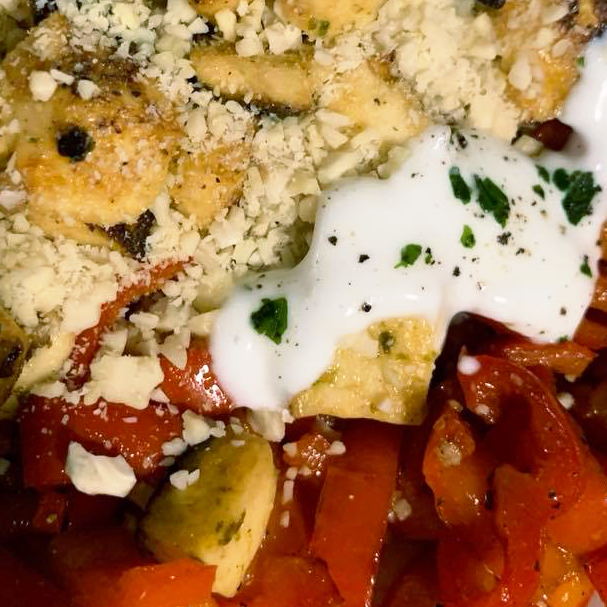
Couscous with halloumi & fried red pepper

For ➍
4 red peppers, cut into strips
335 g whole grain couscous
40 g raisins
40 g almonds, roughly chopped
2 cloves of garlic, pressed or finely chopped
20 sprigs fresh cilantro, finely chopped
2 limes
250 g halloumi, cut into 1-2 cm cubes
125 g fat yogurt
70 cl vegetable stock
3 tbs olive oil
4 tbs extra virgin olive oil
pepper & salt

Grate the zest of the lime. Squeeze the lime.
In a salad bowl, mix the couscous and raisins with the stock and allow to soak, covered, for 10 m. Then stir with a fork.
Heat ½ of the olive oil in a frying pan over a medium heat and fry the pepper strips 7 - 9 m. Season with salt and pepper.
Meanwhile, heat the remaining olive oil in another frying pan over medium heat and fry the lime zest and garlic for 30 s.
Add the cubes of halloumi, fry for 3 - 4 m until crispy. Then remove them from the pan.
Fry the soaked couscous 1 - 2 m in the same pan in the lime-garlic oil.
Mix the coriander with the couscous and season with the extra virgin olive oil, pepper and salt.
Divide the couscous over the plates and scoop the bell pepper strips on the side. Drizzle the couscous with the lime juice and garnish with the halloumi and almonds. Serve the yogurt separately, so that everyone can add it to their own taste.

Couscous sebha godaar
(7 vegetables' couscous)

For ➍
500 g couscous
1 kg lamb (preferably with bones)* 
2 big onions 
1 tomato 
½ ts saffron 
a handful of coriander 
olive oil 
1.5 l vegetable broth 
200 g turnips 
200 g young carrots 
100 g peas 
1 zucchini 
¼ cauliflower 
100 g cooked chickpeas 
a dash of butter 
a few mint leaves
 
Heat the oil and brown the meat. Add the ringed onions. Cover.
Peel the tomato, cut into chunks and, as soon as the onions are glazed, add to the mixture.
Add some of the broth, add the coriander and saffron. Bring to a boil and cook the meat*. (For 500 g, this will take 10-15 m for the meat to heat, and another 10 m to cook).
Meanwhile, chop the vegetables in large chunks and add to the mixture, firm vegetables first.
Steam the couscous on top of the meat and vegetables. When ready, remove the couscous and mix some butter through it.
Serve the couscous on a large plate. Put the meat in the middle, and decorate with some of the vegetables, some sauce and a few leaves of mint of fresh coriander. Serve the vegetables and sauce separately.
*You might prefer to roast the meat separately, with some onions, until done and add it to the vegetables and sauce a few m before serving. While not authentic, it preserves the taste and the structure of the meat very well. Nevertheless, there should be onions to start the vegetables' and sauce preparation.
'Couscous' got its name from the Berber 'k'seksu'. It became the dish we know today in North Africa, with some regional differences in Morocco, Algeria and Tunisia. The latter was adopted by French colonialists and introduced in France as staple food. This recipe can claim to be authentically Moroccan, and refers to the magic power of the number 7. It can be made with 7 other vegetables that taste well together. Couscous can be served with other Moroccan food like Moroccan chicken and Moroccan spiced fish, or even with wokked tilapia. Read more couscous recipes. Read a tip on cooking dried chickpeas.

Chicken* tajine & quinces

For ➍
1 kg chicken in pieces*
2 quinces
2 yellow or white onions
2 tbs sunflower oil
for the charmoula marinade:
2 tbs olive oil
1 ts turmeric powder
1 ts ginger powder
½ ts cumin powder
¼ ts cardamom powder
½ ts pepper
1 ts paprika powder
1½ ts salt zest of ½ preserved lemon
juice of ½ preserved lemon
pinch of saffron, toasted
1 tbs chopped parsley
1 tbs chopped coriander
5 cl of water

Make the charmoula: chop the zest of your pickled lemon very finely. Squeeze out the pulp with your hands. Saffron threads are crushed into small pieces. Mix with the other herbs, spices and olive oil in a bowl. Heat your tajine** until hot.
Cut onions in half and then into slices. Cut quinces into 6-8 wedges. Pour the sunflower oil into your tajine****. Add the onion slices and make sure they are evenly distributed over the tajine.
Then divide the quince wedges over it. Sprinkle the rest of the charmoula over the tajine with a spoon.
Put the tajine** on a low heat. Let it stew for at least 1 h.
Check after 30 m whether there is still enough moisture in the tajine, as the onions release moisture. If necessary, add a little water.
Serve the tajine warm and traditionally with bread.***

*Cook the recipe with pieces of rabbit. You might to adjust the cooking time.
**For those who don't have a tajine: you can follow the steps above in a sturdy casserole.
Or bake in the oven:: bake the chicken golden brown in a pan and then mix it with half of the charmoula. Take a casserole and place half of your onions in it, then place the chicken, the rest of your onions, the quinces, the rest of your charmoula and the water. Cover with aluminum foil. Bake in a preheated oven at 180°C for 30-45 m.
***Or serve with couscous, rice, bulgur or other grains. In the latter case  pay close attention to the moisture level, you will probably have to add the entire 5 cl of water or even more.


Couscous with feta, green cabbage & roasted pumpkin

For ➍
1 butternut squash, pumpkin
¼ green cabbage
200 g of feta
250 g couscous
340 g chickpeas
4 tbs olive oil
1 cube vegetable stock
2 tbs ras el hanout
pepper & salt

Peel the butternut squash. Cut in 2 and remove the pips and the wires. Cut into 0.5 cm halves.
Preheat the oven to 180 ° C.
Arrange the pumpkin pieces side by side on a baking sheet with baking paper and sprinkle with the olive oil. Sprinkle with the ras el hanout and place 15 m in the preheated oven.
Meanwhile, rinse the chickpeas under cold water and drain. Crumble the feta with a fork.
Remove the ribs from the green cabbage and cut the leaves into fine strips.
Turn the pumpkin pieces on the baking sheet and sprinkle with the chickpeas. Season with pepper and salt. Place in the oven for another 15 m.
Dissolve the vegetable broth cube in 6 dl hot water and pour over the couscous. Cover covered for 8 m. Stir loose with a fork.
Cook the green cabbage 2 to 3 m uncovered in slightly salted water. Drain and keep warm.

Stir the vegetables under the couscous and sprinkle with the feta.

Couscous salad with peri peri chicken

For ➍
370 g chicken thigh fillets
3 tbs peri peri sauce medium*
300 g couscous
40 cl boiling water**
3 tbs olive oil
2 avocados
190 g vine tomatoes
1 red onion
75 g arugula salad mix
175 g fresh mango pieces

Brush the chicken fillet with the peri peri sauce. Heat the grill pan without oil or butter and grill the chicken over medium heat for 10-12 m.
In the meantime, put the couscous in a large bowl and pour over the boiling water**. Add the oil and leave covered for 10 m.
Meanwhile, cut the avocados in half lengthwise. Remove the kernel and scoop the flesh out of the skin with a spoon. Slice the flesh. Cut the tomatoes in half and the red onion in half rings. Stir the couscous with a fork and season with salt and pepper.
Mix the couscous with the salad mix. Halve the mango pieces. Slice the chicken thigh fillet.
.
Scoop the couscous on a large plate. Divide the avocados, tomatoes, onion, mango and chicken slices on top.

*Or make fresh peri-piri.
**Add chicken stock power for flavor.
***You can prepare the chicken fillet on the barbecue. Keep the same preparation time.

Moroccan chicken

For ➍
1 tbs olive oil
4 boneless, skinless chicken breasts
1 tbs chicken broth
salt & pepper
100 g cooked or canned chickpeas
1 tbs honey
50 g golden raisins
50 g toasted almonds
2 ts cinnamon
3 ripe tomatoes, peeled & seeded

Heat the oil. Brown the chicken breasts on both sides.
Add cinnamon, tomatoes, broth and salt and pepper. Bring to a boil, lower heat and simmer for 20 m.
Add chickpeas and honey and simmer for an additional 5 m.
Top with toasted almonds.

Serve over rice or couscous.
Read tip on cooking chickpeas.

Grilled salmon & lemon

For ➍
3 lemons
1 red onion
1 clove garlic
6 tbs olive oil
3 tbs boiling water
2 tbs capers
4 Scottish salmon fillets
2 tbs parsley

Scrub the lemon and juice 1 the lemon. Chop the onion and chop the garlic. Heat ⅔ of the oil in a saucepan and add the red onion. Cook 4 m until the onion has softened.
Pour in the lemon juice and boiling water and add the garlic. Simmer on low heat for 3 m to reduce.
Add the capers.
Pat the salmon dry with paper towels and brush lightly with the remaining oil. Sprinkle with salt and pepper. Cut the remaining lemons. Heat a grill pan and grill the salmon fillets in 6 m. Overcooked. Turn halfway. After 2 m, add the lemons (cut side on the grill pan) beside the salmon until they are caramelized. The cutting edge is brown.
Cut the parsley finely and mix with the capers mixture. Place the salmon fillets and lemon halves on plates and spoon the mixture caper over the fish.

Serve with stir-fried spinach, pine nuts and couscous.

Trout & fennel

For ➍
4 trout
2 large fennel bulbs
4 tbs parsley, chopped
juice of 1 lemon
2 lemons, peeled & sliced
juice of 2 oranges
300 g couscous
6 bay leaves
4 cloves garlic, chopped
4 tbs olive oil
coarse sea salt & black pepper

Preheat the oven to 180°C.
Cut the fennel into thin slices using a mandoline and cover the bottom of a casserole.
Grate a little zest of orange using a mandolin, store it and then press the orange.
Sprinkle the dish with the chopped garlic and pour the lemon and orange juice over .
Fill each trout with chopped parsley, bay leaf and a slice of peeled lemon.
Put the trout on the fennel and add the remaining lemon slices. Drizzle with olive oil. Sprinkle with pepper & coarse sea salt.
Put the dish in the oven at 180°C during 35 m.
Meanwhile, prepare the couscous as directed on the package.

Serve the fried trout with fennel along with the couscous.

Couscous & veal shank

For ➍
1 kg veal shank
500 g couscous
1 large sweet onion
150 g chickpeas, soaked or canned
1 butternut squash
2 carrots
1 zucchini
1 l chicken stock
1.5 cinnamon stick
1 tbs ginger powder or ras-el-hanout
1 ts turmeric (or a few strands of saffron)
2 tbs butter or good smen

Cut the rind of the shank pieces to avoid curling.
Peel the onions and chop coarsely. Sauté them in a dash of olive oil at the bottom of the couscoussière or large casserole. Add the veal shank and 1 tbs of butter. Allow to simmer without browning.
Sprinkle the couscous in a large bowl and add a pinch of salt. Pour 1 tbs of olive oil over the couscous and mix the grains well together so they do not stick together.
Add the lukewarm water until the grains are well wet, but not dripping. Allow 5 to 7 m to dry. Rub  the couscous loose between the hands so that the grains are detached from each other. Or make couscous according to instructions on the box *.
Season the meat with the cinnamon stick, saffron, ginger powder, pepper and salt. Deglaze the veal shanks with the stock and simmer for 10 m.
Cut the carrots in pieces of 5 cm. Add the carrots. Peel the butternut squash and cut into pieces of 5 by 5 cm. Add the pumpkin. Add the chickpeas (if canned or jar, add 10 m before the end of cooking). Simmer again for 10 m. Add zucchini.
Full cooking time: ± 1h (possibly slightly shorter for the vegetables).
[Meanwhile steam the couscous. Put the grains in the steam basket of the couscousière and place on top of the pot with the meat. Let stand until the couscous is visible through the steam of the dish.
Remove the couscous from the steamer and sprinkle lightly with water. Rub the couscous loose again in the hands. Repeat this process two more times.]

Before serving, add 1 tbs of butter to the couscous.
Serve the couscous in a large bowl with the meat on top. Dress the chickpeas, onion and butternut and vegetables around the veal shanks and pour over a few spoonfuls of the sauce.

Trapani couscous

For ➍
300 g couscous
1½ tablet fish broth
500 g prawns raw & unpeeled (thawed)
190 g toasted almonds
15 g coriander
20 g flat leaf parsley
10 cl extra virgin olive oil
250 g cherry tomatoes on the branch
4 cloves garlic, minced
2 onions, cut into half rings

Put the couscous in a large bowl. Dissolve 1 broth tablet in 35 cl of boiling water. Pour over the couscous and stir. Leave covered for 10 m. Stand.
Meanwhile peel the prawns, saving the tails. With a sharp knife remove the gut.
Put the almonds, coriander, parsley and oil in a high cup and puree with a hand blender until pesto.
Stir in the couscous with a fork. Keep 2 tbs almond pesto apart and mix the rest with the couscous. Season with pepper and a little salt. Place the tomatoes on the stem on top*.
Heat 1 tbs pesto in a frying pan and fry the garlic for 1 m. Add the onion and cook for 4 m. Add 25 cl of boiling water and ½ tablet of stock. Bring to the boil and simmer 2 minutes. Simmer.
Add the shrimp to the sauce and simmer for 5 m or until done.

Put the sauce in a bowl and toss the rest of the pesto through. Serve with couscous.

*Or add to the pesto.
The Sicilian town of Trapani was founded bij Greek colonists, conquered by Phoenicians, Carthago and Rome. Under Muslim rule, it became an important port for the sale of salt. It is still very close to Africa and continues the culinary traditions. The pesto is adapted from Genuese sailors, coming to Sicily, using local products as tomatoes and almonds.

Pesto alla Trapanese (Sicilian almonds & tomato pesto) (pesto rosso)

For ➍
190 g toasted almonds
15 g coriander*
20 g flat leaf parsley*
10 cl extra virgin olive oil
250 g cherry tomatoes

Put the almonds, coriander, parsley and oil in a high cup and puree with a hand blender until pesto. Add the tomatoes, or serve on the dish.
Serve with couscous or with pasta like penne or farfalle.

*Or 35 g basil

Couscous salad

For ➍
250 g couscous*
4 vine-ripened tomatoes
half a cucumber
1 bunch spring onions, sliced
40 g s fresh parsley
grated zest of a lemon
6 tbs olive oil
2 tbs lemon juice
1 crushed garlic clove

Put the couscous into a large bowl. Pour over the boiling water or stock and stir. Cover with a plate or cling film and leave to stand for 5 m until all the liquid has been absorbed. Separate the grains by roughing them up with a fork.
Finely dice the vine-ripened tomatoes and the cucumber. Slice the spring onions and finely chop the parsley, then add everything to the couscous with the grated zest of a lemon.

Whisk the olive oil, lemon juice and the garlic with plenty of seasoning and drizzle over the couscous. Toss well and serve with some grilled fish, meat or chicken.

*For 2 servings of couscous, you'll need about 125 g couscous and 15 cl of water or stock. For 4 servings, the quantities are 250 g couscous and 30 cl water or stock. For 6, you'll need 350 g couscous and 50 cl water or stock.

Tabbouleh

For ➍
15 g medium bulgur wheat (optional)
30 g fine bulgur wheat (*)
400 g ripe tomatoes
6 spring onions
2 lemons, juice only
½ ts ground black pepper
½ ts ground allspice
½ ts ground cinnamon
½ ts ground coriander
¼ ts ground nutmeg
¼ ts ground cloves
¼ ts ground ginger
175 g flat-leaf parsley
45 g mint
5 tbs olive oil
2 tbs pomegranate arils (optional)

Preheat the oven to 140°C if using the medium bulgur wheat. Rinse the fine bulgur wheat in cold water until the water runs clear, then drain well in a sieve and put in a bowl. Fluff up with a fork.
Rinse the medium bulgur, if using, in boiling water, drain well, spread out on a baking tray and put in the oven for 20 m. Fluff up with a fork when done.
Meanwhile, finely chop the tomatoes and finely slice the spring onions and add both, plus juices, to the wheat. Add the juice of 1½ lemons. Mix the spices together well, and add 1 ts to the bowl.
Douse the herbs in cold water, chop most of the stalks off the parsley, and then take a small bunch, gather together on the board and slice it as finely as you can. Repeat with the rest. Pick the leaves from the mint and do the same, being as gentle as possible.
Add the herbs to the bowl along with the oil, season and toss well. Taste and add more salt, lemon juice or spice mix to taste.

Scatter with the pomegranate and toasted bulgur, if using, just before serving.

*Use couscous instead. Adapt cooking method.

Couscous tfaia (chicken couscous with red onion marmalade)

For ➍
tfaia
500 g couscous
1 complete chicken, cut in pieces
1 large tomato
½ ts white pepper
½ ts ginger
¼ ts cinnamon powder
1 small bush coriander
olive oil
pepper & salt
1 l chicken broth

Braise the chicken in olive oil. Add pepper, ginger and cinnamon. Add pepper & salt, the bush of coriander and the chopped tomato.
Add chicken broth, cover and simmer until chicken is done.
Meanwhile, prepare the couscous.
Serve the chicken, in a large scale, on top of the couscous and cover the chicken entirely with tfaia.

Moroccan spiced fish

For ➍
4 fillets of firm white fish, 150 g each
8 small firm tomatoes
1 clove garlic, crushed
50 g almonds
Moroccan spice blend
8 leaves basil, shredded
olive oil
salt & fresh pepper
1 l salted water
4 sheets of baking paper or aluminium foil

Preheat oven to 200°C.
Brown almonds. Crush them.
Boil 1 l of salted water. Drop tomatoes in for 30 s. Cool under streaming cold water. Remove peels, seeds and juice.
Cube tomato meat. Add salt and pepper, 1 tbs olive oil, crushed garlic.
Brush some oil on both sides of the fish fillets. Add some salt and pepper.
On each sheet, put 3 tbs of tomato mix, a fish fillet, 2 pinches of spice blend, almonds and ½ tbs of oil.
Close the parcels.
Put in oven for 15 m.
Serve with couscous. Add some fresh herbs, like shredded parsley.
'Ras al hanut', 'spices of the master', consists of ginger, roses, cumin, cinnamon, cloves, pepper grains, and cubeb pepper. Each brand has its own specific blend.

Quick couscous @ microwave

For ➋
100 g couscous
¼ ts allspice
1 tbs olive oil
25 cl water
¼ ts freshly ground pepper

Combine couscous and oil in microwave proof casserole and stir until all grains are coated well. Stir in pepper and allspice,if desired. Microwave,uncovered on high for 1 m. Stir well. Pour in water and stir. Microwave, uncovered, on high until water is absorbed and grains are tender, 2 to 3 m. Add 1 tbs if necessary.
Use for a quick bite or let cool to serve as a salad with cold vegetables (and some cold chicken).

Kesksou belfoul (couscous with veal meatballs & broad beans)

For ➍
400 g fresh broad beans, cut
ground ginger
1 ts saffron
4 onions
400 g veal meat, minced*
5 slices of bread
1 bush of parsley
2 bushes of coriander
1 egg
1 ts cumin powder
1 ts cinnamon
2 tbs pistachio nuts (not salted), peeled/pistachio kernels**
salt & black pepper

Grate 2 onions, chop the parsley and 1 bush of coriander. Soak 5 slices of bread in water or milk. Press them dry. Mix onions, parsley, bread, meat, egg, ½ ts of cumin, 1 ts of cinnamon, 2 tbs of pistachio nuts**, salt & pepper. Roll the meatballs with wet hands.
Cut 2 large onions. Heat oil in the lower part of the couscoussière (or a deep skillet like a steamer). Add onions, black pepper, 1½ ts of ginger, 1 ts of saffron, 1 bush of coriander and salt. Sauté on low fire. Add 2 l of water (or enough to contain meatballs and beans).
When the broth is boiling, put in the meatballs. Boil for 20 m.
Put the couscous*** on top in the steaming pan. Cover.****
After 10 m, add the broad beans to the broth. Cover.
When ready, put the couscous on a plate.***** Decorate with meatballs and beans.
Serve broth in a separate bowl.

*Use chopped veal instead of meatballs. Cut into chunks, add to the onions, and braise. Add 2 l of water.
**Use pine nuts instead.
***Moisten couscous the traditional way before steaming, or use precooked. Remove couscous when ready.
****Or: steam couscous in another steamer or, when using precooked, add some of the broth to moisten the couscous.
*****Mix ½ tbs of butter through the couscous.
The secret ingredients of these meatballs are pistachio nuts. Native to Persia, their cultivation was spread by the Islamic conquest of the Mediterranean, and used in luxurious sweets. They add an unexpected taste and crunchy bite to the meatballs.