Showing posts with label vegetarian. Show all posts

Grilled fennel salad with apricots & goat cheese

For ➍
2 fennels
4 large apricots
2 tbs roasted hazelnuts*
1 handful of basil
200 g fresh goat cheese
lemon
salt
olive oil

Heat the barbecue.**
Slice half a fennel into thin slices using a mandoline or a sharp knife. Pour the juice of a lemon over it and add a generous pinch of salt. Mix briefly and let it marinate. Cut the rest of the fennel into slightly thicker slices. Rub with olive oil and salt, and grill on the barbecue**. Use a grill with small openings for this, so that the fennel does not fall through. When the fennel is slightly charred and a little soft, remove it from the barbecue. Cut the apricots in half and remove the pits, then rub with oil. Place them on the grill** with the cut side down for a moment, until they soften slightly and develop black stripes.
Assemble the salad by mixing the roasted and marinated fennel (and the lemon juice in which they marinated) with the grilled apricots. Place the goat cheese on top and finish with the basil leaves and hazelnuts*.
Season with salt and pepper, and drizzle with some good olive oil.

*Replace with walnuts.
**Use a grill pan for small quantities if necessary.

Gnocchi with mushrooms & sage

For ➍
2 ts ground black pepper 
olive oil 
1-2 tbs white balsamio vinegar 
300 g mixed mushrooms, torn into large pieces 
15 sage leaves 
sea salt 
250 g gnocchi 
100 g Parmigiano, finely grated 
50 g Pecorino, finely grated 

Toast the peppercorns in a large, hot, dry skillet over medium heat until fragrant. Then crush them coarsely in a mortar and set aside. Place the skillet back on the heat and heat a deep layer of olive oil in the skillet. Add the sage leaves and fry for 1 m, until nice and crispy. 
Remove the sage leaves from the pan and add the mushrooms. Fry them for about 5-10 m. Season with salt. Meanwhile, bring a large pot of salted water to a boil. Add the gnocchi and cook them for 2-3 m until they float to the surface. Scoop them out with a slotted spoon and reserve 10 cl of the cooking water. 
Add the roasted ground peppercorns to the mushrooms. Add the white balsamico vinegar. Also add (part of) the pasta water and let simmer for 2 m, until the liquid has reduced by half. 
Add the drained gnocchi to the pan and toss them in the sauce. Also add the cheeses immediately and mix until the sauce is smooth. Divide the mushroom gnocchi among the plates and finally sprinkle with extra cheese. Serve the mushroom gnocchi with a salad. 

Risotto & oyster mushrooms

For ➋
120-180 g risotto rice
200 g small oyster mushrooms
1.5 shallots
1 clove of garlic
10 g sage
30 g flaked almonds
10 cl almond milk
20 g grated Parmigiano
75 cl vegetable stock (or poultry stock)
4 cl white wine (or mirin)
2.5 cl soy sauce
2 tbs butter/olive oil
Salt & pepper

Heat the olive oil in a non-stick pan. Fry half the sage leaves in the olive oil for 1 minute until crispy. Remove and drain on paper towels.
Bring the vegetable stock to a boil and season with the soy sauce. Peel and finely chop the shallots and garlic. Sauté them together in hot butter until translucent. Deglaze with the white wine and add the rice. Cook briefly, stirring well. Gradually add the chicken stock, stirring regularly. Add a ladleful of stock each time the previous one is absorbed. Remove from the heat when all the stock has been absorbed and the rice is al dente. Stir in the almond milk, a little butter, and the Parmesan cheese. Stir in the remaining sage. Clean the mushrooms and sauté them in a little olive oil in a separate pan. Season with salt and pepper. Serve the risotto with the sage and the sautéed oyster mushrooms. Toast the flaked almonds in a pan without oil and garnish the risotto with them.


Read the tip on making a quick risotto.

♥︎Roasted pumpkin & fregola

For ➋
2 small round pumpkins* (Hokkaido type) or 1 large one (approximately 1 kg unpeeled weight)
3 white onions
200 g pearl couscous*** or fregola Sarda
100 g Parmigiano
20 sage leaves
olive oil
lemon juice
salt & pepper
chili flakes (optional)***

Preheat the oven to 210°C. Meanwhile, cut the pumpkin(s) into wedges about 2 cm wide, after scooping out the seeds. You don't need to peel the pumpkin; roasting softens the skin, making it perfect to eat.
Toss the pumpkin wedges with olive oil, salt, and pepper. Peel the onions and cut them into six wedges. Toss the onions with olive oil, salt, and pepper. Roast the onion and pumpkin in the oven for about 30 minutes, or until the pieces are tender and browned at the edges. Place the pumpkin pieces far enough apart in the oven so they roast well (and don't steam through). Keep the onions separate: they can go on the same baking sheet, but don't mix them with the pumpkin; we'll use them separately later.
For the pasta sauce, blend half the roasted pumpkin with 65 g grated Parmigiano. You can do this with an immersion blender or a food processor. Deglaze the empty pumpkin baking sheet with a splash of water and scrape up any browned bits with a wooden spoon. Add this juice to the sauce, along with a squeeze of lemon juice. Taste and season with salt and pepper. Set the other half of the roasted pumpkin pieces aside.
Simmer the pearl couscous in salted water for about 8 minutes, until tender. Taste regularly (and reserve a cup of the cooking liquid when draining the pearl couscous). Meanwhile, heat a generous amount of olive oil in a large pan. Sauté the sage leaves over medium heat (not too hot, otherwise the leaves will brown and become bitter). Turn them over and season with salt. Remove them from the pan and place them on a paper towel to drain and cool.

Mix the pearl couscous into the pumpkin sauce. Add a little more cooking liquid, if necessary, to loosen the sauce. Serve with the remaining roasted pumpkin and the onion on top, and garnish with the sage leaves and the remaining Parmigiano cheese.***

*Don't use butternut squash for this dish; that silky squash is delicious in soups or stews. But for roasting, I prefer a firm, round squash. It holds its shape better and roasts beautifully brown.

**Other small pasta such as shells, spiralized or short macaroni, or nutty whole wheat pasta.

***the sweet, mild flavors of pumpkin and onion are enhanced by a bit of heat. A generous pinch of mild chili flakes (like Aleppo flakes) is also delicious.


Gnocchi with pumpkin & spinach

For ➍
butternut squash (peeled, deseeded, cubed)
800 g baby spinach
1 onion (peeled & chopped)
1 tbsp fresh sage (chopped)
500 g gnocchi
50 g grated Parmigiano
2 tbs olive oil
pepper

Heat the olive oil in a Dutch oven and sauté the onion until translucent. Add the pumpkin cubes and sage and cook for about 12 m, stirring occasionally, until the pumpkin cubes are soft.
Add 50 cl water and bring to a boil. Add the gnocchi. Cook uncovered over low heat for 3 m.
Rinse the spinach and add it to the pan. Let the spinach wilt.
Stir in the Parmigiano, season with salt and pepper, and serve.

♥︎Spicy Moroccan carrots

For ➍-➏
500 g carrots
marinade:
juice of ½ lemon (2 tbs)
3 large garlic cloves
¼ cup fresh parsley, finely chopped
¼ cup fresh coriander, finely chopped
4 tb olive oil
1 ts honey
1 ts sweet paprika
½ ts hot paprika
½ ts ground cumin
½ ts salt

Peel carrots. Cut into 1.5cm slices. Cover with hot salted water. Bring to the boil. Reduce heat and cover. Simmer for 15m. Drain and steam.
Crush garlic with salt to a paste. Thoroughly mix all marinade ingredients in a bowl.
Add warm carrots to marinade. Toss gently to coat
Cover and refrigerate for 1-2 h, stirring occasionally.

Roast pumpkin soup with walnuts & herb oil

For ➏ 
1 kg pumpkin, such as kabocha 
400 g sweet potatoes, unpeeled 
15 cl olive oil 
5 g sage leaves 
1 red chilli, thinly sliced on an angle (10 g) 
1 leek, trimmed & cut into 2mm rounds (200 g) 
1 large onion, peeled & roughly chopped (240 g) 
10 g piece fresh ginger, peeled & julienned 
fine sea salt 
½ ts smoked paprika 
½ ts ground coriander 
2 small potatoes (200 g) 
60 g walnuts 
1½ tbs maple syrup 
10 g coriander leaves, finely chopped 
10 g parsley leaves, finely chopped 
1 ts finely grated lemon zest 

Heat the oven to 220° C (200° C fan)/425F/gas 7. Put the whole pumpkin and sweet potatoes on a baking tray lined with greaseproof paper and roast, turning once halfway, for an hour, until soft and golden. Remove and turn down the oven to 180° C (160° C fan)/350F/gas 4. Once they’re cool enough to handle, use a metal spoon to peel off the pumpkin and sweet potato skins, and to scoop out the pumpkin seeds. Meanwhile, put 80ml olive oil in a small saucepan on a medium heat, then add the sage leaves and fry for about 2 m, until deeply green. Use a slotted spoon to lift out the sage, transfer to a sheet of kitchen paper and leave to crisp up. Add the chilli to the hot oil, fry, stirring occasionally, for about 2 m, until deeply red, then transfer to the kitchen paper alongside the sage. 
Transfer the hot oil to a large saucepan on a medium heat, add the leek, onion, ginger and three teaspoons of salt, and cook, stirring occasionally, for 5 m, until soft and translucent. Add the smoked paprika and ground coriander, cook for a minute, until fragrant, then add the cooked pumpkin and sweet potato flesh, and 1.6 litres of water. Peel and grate the potatoes on to a chopping board, then add to the soup before they discolour. Bring the soup to a boil, then turn down the heat and simmer for 15 m. While the soup is cooking, make the nut brittle. Line a small baking tray with greaseproof paper, top with the walnuts, maple syrup and a quarter-teaspoon of salt, and toss to coat. Roast, stirring once halfway, for about 10 m, until toasted and golden brown, then remove, sprinkle the fried sage and chilli on top, toss to combine and leave to cool. 
Once the nut mix is cool, scrunch up the paper to crush the brittle into smaller pieces. Make the herb oil by combining the coriander, parsley, lemon zest, remaining 70 ml oil and a quarter-ts of salt in a small bowl. Once the soup has cooked, take off the heat and blitz with a stick or regular blender until smooth and velvety. Add a splash more water to loosen, if need be, then divide between six bowls. Scatter the maple walnut brittle on top and serve drizzled with the herb oil.

♥︎Fregola Sarda with shimeji in lemon & tarragon sauce

For ➋ 
150 g fregola Sarda
2 garlic cloves
200-300 g shimeiji (or torn oyster mushroom)*
½ lemon, grated zest & juice
handful tarragon, chopped
1 spring onion, sliced ​​
handful sunflower seeds
olive oil
mushrooms* (optional)
feta** (optional)

Bring a pot of salted water to the boil and cook the fregola sarda until al dente in 8 m. Drain and cool under cold running water. Crush the garlic. Tear the oyster mushrooms into strips and slice the mushrooms. Wash the lemon well and grate the zest. Squeeze the juice from the lemon. Finely chop the tarragon. Cut the spring onions into rings. Roast the sunflower seeds in a non-stick pan without fat on a medium heat. Remove from the pan when they start to colour.
Heat the olive oil in the pan and fry the mushrooms and oyster mushrooms until golden brown and crispy in 5-7 m. Then add the garlic and fry for 2 m. Deglaze the pan with the lemon juice and stir in the lemon zest and half of the tarragon.
Put the fregola sarda in a bowl and stir in the rest of the finely chopped tarragon and the extra virgin olive oil. Season with salt and pepper. [
Spoon the fried mushrooms on top*]. Sprinkle the roasted sunflower seeds on top. [Crumble the feta over it**]. Finish with the spring onions.

*If wanted, replace some with sliced ​​mushrooms
**If wanted.

♥︎Smashed Asian cucumber salad

For ➍ 
2 seedless cucumbers (about 600 g) 
1 ts salt 
2½ ts sugar 
2 ts sesame oil 
3 ts light soy sauce 
1½ tbs rice vinegar 
2-4 cloves of garlic (finely chopped) 
1-2 ts chili oil (optional)* 
2 ts toasted sesame seeds 
a small handful of chopped coriander 

Wash the cucumbers and pat them dry with a clean towel. 
Make the salad dressing by combining the salt, sugar, sesame oil, light soy sauce, and rice vinegar. Stir until the sugar and salt are completely dissolved. Set aside. 
On a cutting board, lay a large knife flat against the cucumber, and smash it lightly with your other hand. The cucumber should crack open and smash into four sections. Repeat along its full length. Once the whole cucumber is completely open (usually into 4 long sectional pieces), cut it at a 45-degree angle into bite-sized pieces. 
In a large bowl, mix the cut cucumber with the prepared dressing, garlic and chili oil. Toss it well. 
Serve, garnished with sesame seeds and coriander. 

*If you prefer to omit the chili oil, heat up 1 tbs of oil in a pan and drizzle it over the cucumber. 

♥︎Fregola, cucumber & orange

For ➋ 
2 small cucumbers about 150 g* 
1 tbs caster sugar 
1 ts sea salt 
1 ts coriander seeds 
5 tbs white wine vinegar 
2 tbs dill, finely chopped
150 g fregola Sarda** 
2 tbs olive oil 
1 large orange
2 spring onions, finely chopped 
a handful of watercress 

To make the pickle, thinly slice 1 cucumber and put in a small mixing bowl. Mix the sugar, sea salt, coriander seeds, vinegar and dill and stir until the sugar has dissolved. Pour over the cucumber, cover and place somewhere cool for at least 1 hour. The cucumber will darken a little in colour and soften slightly, but should retain its crunch. 
Bring a saucepan of water to the boil, salt it lightly, then tip in the fregola. Simmer for about 10 m, testing regularly for tenderness. Drain thoroughly, tip into a bowl then sprinkle a few drops of olive oil over it and toss to coat evenly. This will stop the beads sticking together as they cool. 
Peel the second cucumber, halve it lengthways and cut it into 1cm chunks. Peel the orange with a kitchen knife, taking care to remove the white pith, then cut into thin slices. Warm the oil in a shallow pan, add the raw cucumber pieces and continue to fry them gently. 
Add the spring onion to the pan with the drained fregola. Season with salt and black pepper. Fold the pickled cucumber and its liquid into the ingredients, add the watercress then stir briefly. 
Divide between plates and place the orange slices at its side. 

*When using larger cucumber, cut the slices in half. 
**Use Sardinian roasted fregola. Or plain pearl couscous

♥︎Spanakorizo ​​(Greek spinach rice).

For ➋
400 g spinach leaves (wild spinach)
150 g onions
20 g dill
4 tbs olive oil
120 g carnaroli rice
5 cl dry white wine
25 cl water
1 lemon
salt & freshly ground black pepper

Check the spinach, wash it several times in plenty of water, drain and chop coarsely. Peel the onions and chop them finely. Remove the dill from the stems, set some tops aside and chop the rest finely.
Heat 2 tbs olive oil in a heavy-bottomed saucepan over medium to high heat. Fry the onions until translucent; stir regularly.
Add the rice and fry briefly. Deglaze with the wine. Reduce the wine almost completely.
Add the chopped spinach and let it shrink. Add 25 cl of water, add some salt and let it simmer without a lid for about 15 m (depending on the type of rice) over low heat, until the rice is al dente; stir occasionally.
The rice should be cooked, but not falling apart. 
Stir in the dill. Season with the finely grated zest of ½ lemon, 1-1½ tbs lemon juice, 1-2 tbs olive oil and black pepper. The rice should taste fresh and lemony.
Divide the spinach rice over two deep plates. If desired, drizzle some olive oil over it and grate over the zest of a few lemon wedges. Sprinkle the dill tops over it.


♥︎Kikerage & enoki with udon noodles

For ➋
25 g dried kikerage (black fungus)
1 tbs sunflower oil
1 tbs mirin
100-150 g udon noodles
100 g fresh enoki, without feet, in 2 portions
5 g plant butter
3 scallions, cut in rounds
2 garlic cloves, chopped or crushed
1 tbs furikake

Pour warm water over the kikerage and let it soak for 15 m to 1 h. Drain it, and use as a base to cook the udon. If necessary, add some water. Heat and dissolve 1 tbs miso in it. Cook the miso as directed.
Meanwhile, fry the kikerage for 5-7 m in 1 tbs sunflower oil. Add a dash of mirin and let evaporate. Set the kikerage aside in another container. Stew the onion and garlic for 2 m in the same pan, with a little oil.
In the meantime, cook the enoki with a few small lumps of plant butter in 2 packets 1 m in the microwave.
Mix the kikerage with the onion and garlic.
Let the udon drip. Place on plate. Mix the kikerage and onion over it. Sprinkle with furikake.
Place the enoki on the plate.  Serve.
Kikerage is an edible mushroom and is a popular condiment in Japanese ramen noodles. It is also commonly known as wood ear mushroom, black fungus, jelly ear, jew’s ear, and mu-er in Chinese. It is known for its nutritious value.The edible mushroom gets its name from resembling the shape of an ear. Kikurage has a smooth surface on both sides and is dark brown in colour. Raw wood ear mushrooms carry a light woody fragrance. Once cooked, the mushroom is gelatinous and easily absorbs the flavours in the dish. To rehydrate wood ear mushroom, soak the desired amount in cold water for 1 to 2 h. The wild mushrooms can expand 3-4 times in size. For faster results, soak the dried kikurage in warm water for 20 m. However, the mushrooms will not expand as much and will be less crunchy. Once rehydrated, store in the fridge and consume within 1-2 days.

Easy miso sauce for noodles

For ➍ 
1 heaping tbs white miso paste 
1 tbs plain peanut butter or Chinese sesame paste 
1 tbs toasted sesame oil 
½ tbs chili garlic sauce, adjust according to desired spice 
½ tb soy sauce 
1 ts dark soy sauce, optional for colour 
½ tbs maple syrup or other sweetener like mirin
½ tbs rice vinegar or distilled white vinegar 
1 ts minced garlic 
1 scallion chopped 

Mix everything together. Add to the boiled and drained noodles.

Green apple & kale salad

For ➍
3 cups ribbed & chopped kale or borecole
handful of chopped parsley
1 cup cooked black lentils
1 green apple, diced
1/2 English cucumber, diced
½ cup toasted pumpkin seeds
1 cup shaved Parmigiano, or feta or goat cheese
dressing
one clove garlic
1 tbs honey
1 tbs Dijon mustard
juice of 1 lemon
¼ cup pumpkin seed oil or extra virgin olive oil
salt &pepper

In a large salad bowl, combine the kale, parsley, lentils, apples, cucumber, pepitas and parmesan.
For the dressing, blitz everything in a food processor or blender, with salt and pepper to taste, until the garlic is smooth.
Pour the dressing on the salad and toss well to coat. Garnish with more cheese if you wish. The salad will keep in the fridge for a full day and slowly loose it's crunch from there.

Couscous with halloumi & fried red pepper

For ➍
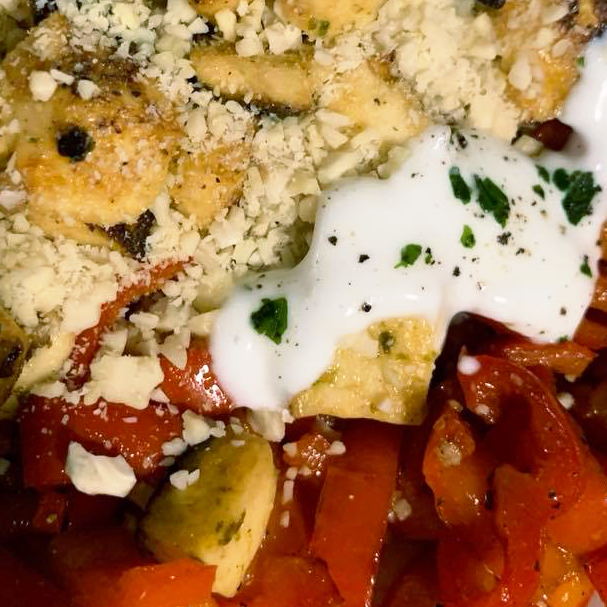
4 red peppers, cut into strips
335 g whole grain couscous
40 g raisins
40 g almonds, roughly chopped
2 cloves of garlic, pressed or finely chopped
20 sprigs fresh cilantro, finely chopped
2 limes
250 g halloumi, cut into 1-2 cm cubes
125 g fat yogurt
70 cl vegetable stock
3 tbs olive oil
4 tbs extra virgin olive oil
pepper & salt

Grate the zest of the lime. Squeeze the lime.
In a salad bowl, mix the couscous and raisins with the stock and allow to soak, covered, for 10 m. Then stir with a fork.
Heat ½ of the olive oil in a frying pan over a medium heat and fry the pepper strips 7 - 9 m. Season with salt and pepper.
Meanwhile, heat the remaining olive oil in another frying pan over medium heat and fry the lime zest and garlic for 30 s.
Add the cubes of halloumi, fry for 3 - 4 m until crispy. Then remove them from the pan.
Fry the soaked couscous 1 - 2 m in the same pan in the lime-garlic oil.
Mix the coriander with the couscous and season with the extra virgin olive oil, pepper and salt.
Divide the couscous over the plates and scoop the bell pepper strips on the side. Drizzle the couscous with the lime juice and garnish with the halloumi and almonds. Serve the yogurt separately, so that everyone can add it to their own taste.

Easy pistou

For ➍
80 g pine nuts
40 g basil
1 garlic clove, finely chopped
10-12.5 cl olive oil

Toast the pine nuts in a dry frying pan until they are nicely browned. 
Set aside 12 basil leaves. 
Place the rest of the basil leaves, garlic and half the pine nuts in the bowl of the food processor and pulse a few times. While the machine is running, pour in as much oil as needed for a runny sauce in a trickle. Taste and season the pistou with salt and pepper.

♥︎Tray bake of giant beans
with ratatouille vegetables & pistou

For ➍
2 cans giant white beans (400 g each), rinsed & drained
2 red onions, peeled, cut into 8 wedges each
2 red bell peppers, chopped
1 eggplant, in pieces
1 zucchini, in pieces
4 small tomatoes on the vine, each cut in 4 wedges
3 garlic cloves, thinly sliced
2 tbs rosemary needles, coarsely chopped
1 red chilli pepper, in rings
pinch chilli flakes
salt pepper
4 tbs olive oil
For the pistou*:
80 g pine nuts
40 g basil
1 garlic clove, finely chopped
10-12.5 cl olive oil

Preheat the oven to 200 °C.
Put the beans, all the vegetables, the garlic, rosemary, chilli pepper and chilli flakes, four tablespoons of olive oil, a good pinch of coarse salt and a pinch of pepper in a bowl and toss. Divide the mixture over two baking trays lined with parchment paper.
Slide the baking trays into the oven and roast for 45-60m, until the vegetables are tender and the beans are just a little crunchy. Switch the baking plates halfway through, so that they both receive the same amount of top and bottom heat.
For the pistou, toast the pine nuts in a dry frying pan until they are nicely browned. Set aside 12 basil leaves. Place the rest of the basil leaves, garlic and half the pine nuts in the bowl of the food processor and pulse a few times. Then, while the machine is running, pour in as much oil as needed for a runny sauce in a trickle. Taste and season the pistou with salt and pepper.
Transfer the beans and vegetables to a serving platter. Sprinkle over the rest of the pine nuts and the reserved basil leaves. 
Serve the pistou separately.

*Pistou is the Provencal version of Italian pesto. It's basically the same sauce without Parmigiano.

♥︎Vegan tajine of sweet potato, fennel & olives

For 
4 tbs olive oil
3 fennel bulbs, each in 8 wedges & keep the greens
juice & pulp of 2 oranges
juice & pulp of 1 lemon
2 red onions, in half moons
3 garlic cloves, sliced
3-5 sprigs of thyme
25 cl boiling water
1-2 tbs harissa
750 g orange sweet potatoes, peeled & chopped
100 g  black olives

Heat the olive oil in a heavy casserole or tagine. Add the fennel pieces and a pinch of salt and fry the vegetables for 8-10 m. Use tongs to turn the pieces so that they brown on all sides. Remove the fennel pieces from the pan and keep apart.
Put the onion in the pan and let it fry for 2 to 3 m. Add the garlic and thyme and fry for 1 m.
Fill a measuring jug with 25 cl of boiling water and dissolve the harissa in it. Add the orange and lemon juice and, if desired, a pinch of salt and pour this broth into the pan with the onions.
Add the sweet potato pieces and the fried fennel, toss gently and bring to the boil. Put a lid on the pan and turn the heat to low. Let simmer gently for 15 m.
Remove the lid from the pan and add the olives. Carefully toss again and let everything simmer for another 15 m without a lid, or until the sweet potato is cooked through.
Finely chop the fennel greens and sprinkle over the tajine before serving.

*Serve this dish with a whole grain of your choice, such as whole grain couscous, pearl barley, buckwheat, whole grain rice or quinoa. The last three are gluten-free. 
**Serve with a green salad.


Pomodoro torte di Amalfi
(tomato & olive tarts)

For ➍
dough:
120 g Italian '00' flour, plus extra for dusting
55 g polenta/cornmeal
70 g ricotta
70 g cold unsalted butter*
large egg (yolk only)
topping:
250 g plum tomatoes
10 cherry tomatoes, quartered
fresh thyme leaves, chopped
1 tbs fresh oregano, chopped
125 g goat cheese**
handful of olives, pitted olive oil,
to sprinkle basil leaves, for garnish
sea salt &freshly ground black pepper

For the dough, place all ingredients in a food processor and mix until smooth. Place the dough on a floured work surface and shape into a large ball. Divide this into separate pieces (1 per person) that you flatten a bit. Wrap and let rest in the refrigerator for 30 minutes.
Meanwhile, pour the can of tomatoes into a sieve and collect the juice for a drink. Chop the tomatoes.
Preheat the oven to 180°C.
When the dough is chilled, roll it out into 3mm thick circles on a floured work surface (the dough should be a little rustic around the edges). Top each circle with some drained tomatoes, chopped cherry tomatoes and season to taste. Add the thyme and oregano and crumble some goat cheese over it. Decorate with olives and drizzle with a little olive oil.
Bake for 20 m in the preheated oven, garnish with basil.

*Use same amount olive oil instead.
**Use melting light cheese instead.

Moussaka

For ➍ 
600 g potato, sliced 
2 large eggplants, in thin slices of 3 mm. 
2 tbs flour or cornflour oil (for frying) 
handful of fresh parsley (for garnish) 
300 g minced beef or vegetarian minced meat 
1 onion pinch of oregano 
2 cloves of garlic 
1 ts cinnamon 
2 tbs tomato paste 
40 cl tomato cubes 
béchamel:*
30 cl of milk 
30 g butter 
30 g flour 
1 bay leaf 
50 g grated cheese 
pinch of nutmeg 
1 egg 

Heat a grill pan. Brush the eggplants with a little oil and sprinkle with a little salt and pepper. Grill them nicely brown and then sprinkle with a little flour. 
Finely chop the onion and garlic and fry in a (wok) pan for a few m. Add the minced meat and fry it.  Add the oregano, cinnamon, salt and pepper and the tomato cubes and puree. Let this simmer for 20 m. Taste to see if the sauce is well seasoned. 
Preheat the oven to 180°C. 
Heat the butter in a saucepan for the béchamel sauce. Add the flour and fry the roux for 5 m. Then add the milk little by little and keep stirring with a whisk until there are no lumps left. Add the bay leaf and let it simmer for a few m. Melt about 25 g of cheese in the sauce and season with salt, pepper and nutmeg. Let the sauce cool down a few m, remove the bay leaf and then also beat the egg into the sauce. 
Grease the baking dish with a little oil. Spread about half of the grilled eggplant over the bottom of the baking dish. Divide the potato slices over this. Cover with the layer of minced meat mixture. Divide the rest of the aubergines over this. Pour the béchamel sauce over this. Sprinkle with the rest of the cheese. 
Place the moussaka in the oven for about 45 m. 
Let cool a few m, garnish with parsley and divide the moussaka into pieces. 

*Replace the béchamel sauce with 20 cl Greek yogurt mixed with 2 eggs to make a gluten-free moussaka.